
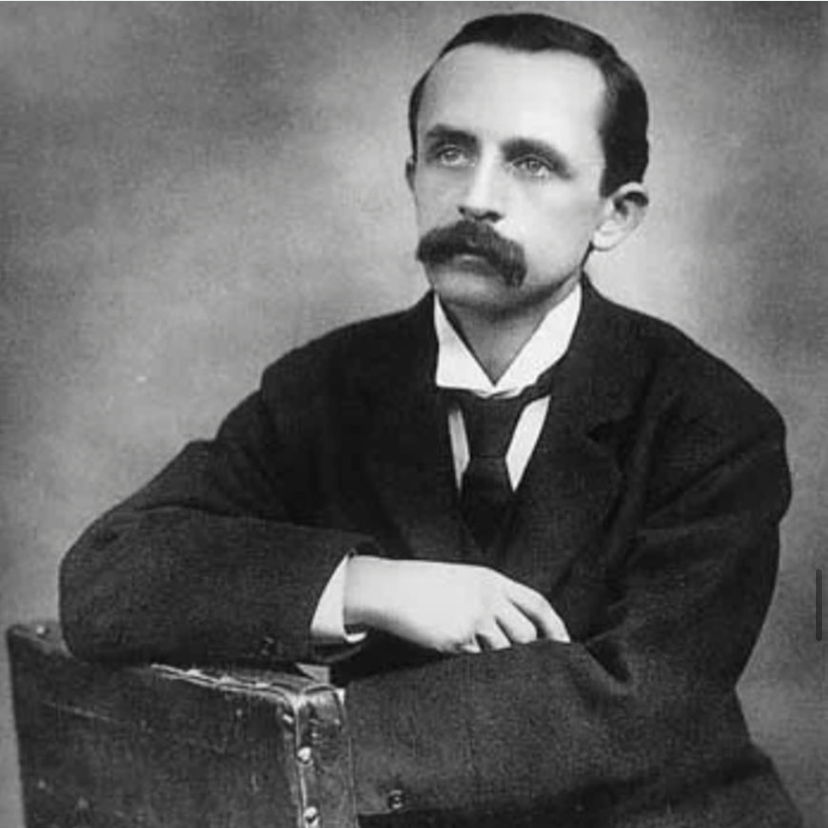
Scottish playwright and novelist James Matthew (J. M.) Barrie was BOTD in 1860. Born in Kirriemuir, Angus, the son of a weaver, his childhood was scarred by the death of his elder brother. He studied at the University of Edinburgh, working as a journalist in Birmingham before moving to London in 1885 to pursue a writing career. His early books Auld Licht Idylls and The Little Minister, sentimental recollections of his Kirriemuir childhood, were bestsellers. He found huge success as a playwright, dominating the West End stage with light comedies Ibsen’s Ghost, Quality Street and The Admirable Crichton. He is best known for his 1904 play Peter Pan, or the Boy Who Wouldn’t Grow Up, a fantasy about a flying boy in the island of Neverland, combatting pirates and Indians with the help of the fairy Tinker Bell, the Lost Boys and the three Darling children. A theatrical sensation, it was followed by a book version in 1906. Peter was inspired by Barrie’s friendship with George and John Llewellyn Davies, two boys whom he befriended while walking in Kensington Gardens. Barrie eventually met their mother Sylvia and became a surrogate family member, referred to as “Uncle Jim” by George, Jack and their younger brothers Peter, Michael and Nicholas. After Sylvia’s death in 1910, he became the boys’ legal guardian. His own marriage to actress Mary Ansell was unconsummated, ending in divorce in 1909. Barrie outlived two of the Llewelyn boys – George, who was killed in battle during World War One, and Michael, who drowned in 1920 in what appears to be a suicide pact with his boyfriend. One of the most beloved writers of the Edwardian age, he was created a baronet in 1913 and was awarded the Order of Merit in 1922. He died in 1927, aged 77, assigning the copyright in his Peter Pan stories to the Grewat Ormond Street Children’s Hospital in London. Barrie’s sexuality has been extensively debated by biographers, who have argued variously that he was sexually attracted to children, asexual or a closeted gay man. He had a passionate, romantically charged correspondence with the writer Robert Louis Stevenson, writing “To be blunt I have discovered (have suspected it for some time) that I love you, and if you had been a woman…”, though the two men never met in person. Barrie was played by Johnny Depp in the 2004 film Finding Neverland, a sentimental and sexually sanitised account of his relationship with the Llewelyns. Peter Pan remains one of the most famous characters in children’s literature, boosted by the global success of Walt Disney’s 1953 animated film. Peter has also been used as a code-word for homosexuality, and interpreted as an avatar for the narcissism and youth-obsession of male homosexual culture.
J. M. Barrie

 Super Gays Born on this Day