
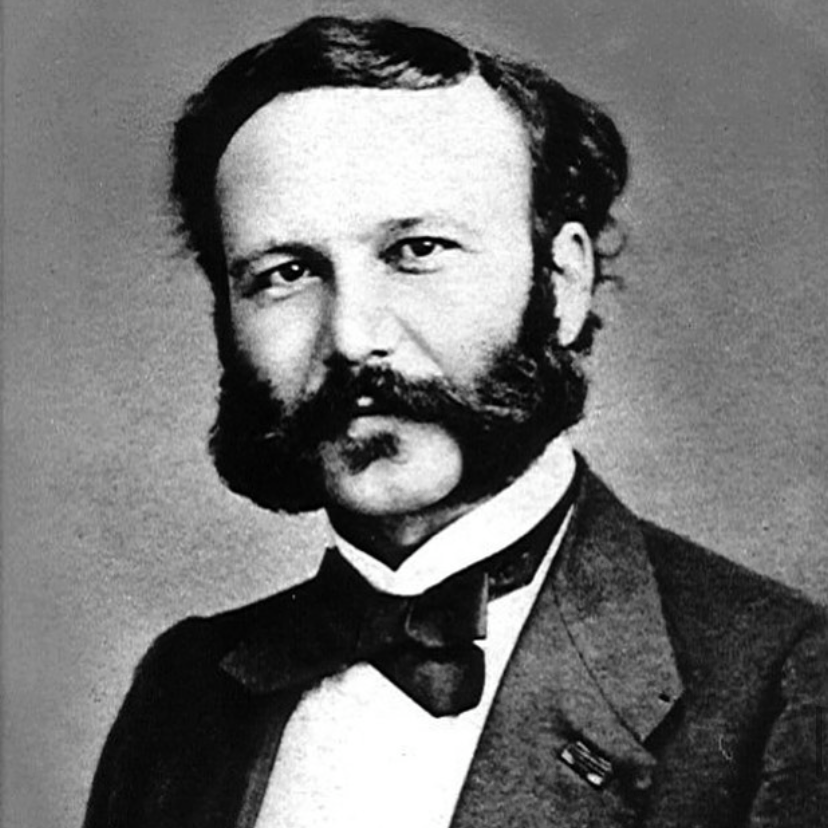
Swiss humanitarian Jean-Henri Dunant was BOTD in 1828. Born in Geneva to a prominent Calvinist family, he studied at the Collège de Genève, leaving aged 21 due to poor grades, and began an apprenticeship with a banking firm. Following his parents’ example, he became involved in various social work initiatives. In 1852, he founded the Geneva chapter of the Young Men’s Christian Association, and attended the 1855 Paris convention that established the YMCA as an international organisation. The following year, he set up a business to trade in French-controlled Algeria. After problems securing land and water rights, he decided to petition French emperor Napoléon III, at the time stationed with his army in Lombardy during the Austro-Sardinian War. While en route, Dunant witnessed the Battle of Solferino, a bloodbath resulting in nearly 40,000 deaths. Horrified, he organised emergency aid services, arranged for the release of imprisoned Austrian doctors and encouraged locals to assist the wounded without regard to their side in the conflict. He published Un Souvenir de Solferino (A Memory of Solferino) in 1862, advocating for voluntary relief societies and an international agreement to aid the war wounded. In 1863, he founded the International Committee for the Relief of the Wounded (now the International Committee of the Red Cross), and aided the creation of the Geneva Convention. By 1867, he was accused of financial corruption and homosexuality, prompting him to declare bankruptcy and leave Geneva. He lived in poverty in cities across Europe for nearly a decade. News stories about the Red Cross published in 1895 re-introduced him to the public, and he received a number of donations, enabling him to return to Switzerland and retire to a nursing home in Heiden. In 1901, he was awarded the first Nobel Peace Prize, shared with French pacifist Frédéric Passy. He continued advocating for the treatment of prisoners of war, the abolition of slavery, international arbitration, disarmament and Zionist causes until his death in 1910, aged 82. In 1924, the German gay magazine Der Eigene claimed that an exchange of letters between Dunant and the “Comte de M.” suggested a homosexual attraction. Biographers have also suspected Dunant’s family of rewriting his memoirs and suppressing details of his homosexuality, though little evidence to support this. Dunant was portrayed by Jean-Louis Barrault in the 1948 biopic D’homme à hommes (Man to Men).
Henri Dunant

 Super Gays Born on this Day