
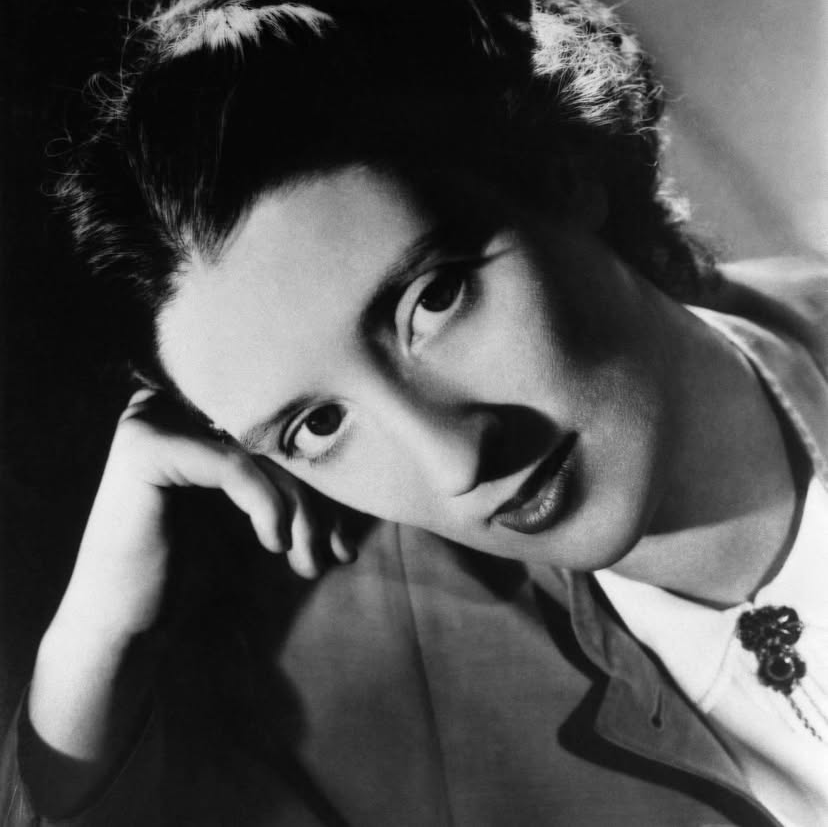
Belgian writer Eleanore (May) Sarton was BOTD in 1912. Born in Wondelgem, Ghent, she was the only child of a middle-class couple. When German troops invaded Belgium in 1914 at the start of World War One, the family fled to England before emigrating to America, settling in Boston. Sarton was educated in Cambridge, turning down a scholarship to Vassar College to pursue an acting career. She moved to New York City, apprenticing at Eva Le Gallienne‘s Civic Repertory Theatre and began writing poetry. In 1929, she travelled to Europe, living in Paris for a year, and socialising with literary celebrities including Virginia Woolf and Elizabeth Bowen. She also befriended and had affairs with married couple Juliette and Julian Huxley. Returning to New York, she founded the Apprentice Theatre in 1933; after it disbanded in 1936, she taught creative writing, wrote scripts for the Overseas Film Unit and began publishing her work. Her 1937 poetry collection Encounter in April turned heads with its vivid erotic female imagery. She became a prolific writer, publishing 19 novels, 17 volumes of poetry and two children’s books, as well as plays and screenplays. Much of her work, notably the 1965 novel Mrs Stevens Hears the Mermaids Singing, focused on love between women, though she resisted categorisation as a “lesbian writer”. In later life, she published a series of critically praised memoirs, addressing issues of aging, solitude, friendship, love and relationships and (her) lesbian identity. Sarton had a 13-year relationship with Judy Matlack, separating in 1956. Her biographer Margot Peters chronicled Stevens’ tumultuous relationship history, concluding that “people who had the misfortune to become her intimates almost universally came to regret it”. Sarton retired to York in Maine, continuing to write and publish after suffering a stroke. She died in 1995, aged 83. Her final memoir, Coming into Eighty, was published after her death. Mrs Stevens was adapted into a feature film in 2004.
May Sarton

 Super Gays Born on this Day