
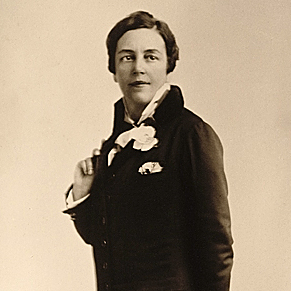
American painter Beatrice Romaine Goddard, better known as Romaine Brooks, was BOTD in 1874. Born in Rome, Italy to a wealthy American family, she was raised in New York by her mother, who subjected her to years of physical and psychological abuse. Eventually rescued by her grandparents, she attended a series of boarding schools, moving to Paris when she was 19. Existing on a meagre allowance from her mother, she worked briefly in cabaret before giving birth to a daughter, whom she gave up for adoption. She moved to Rome to study art, leaving her class following sexual harassment by a male student, and relocated to Capri. The death of her mother in 1902 made her independently wealthy. The following year, she entered into a marriage of convenience with John Ellingham Brooks, enabling her to obtain British citizenship. She moved to Paris in 1905, establishing herself in literary and artistic circles, and having affairs with celebrity lesbians Winnaretta Singer and Ida Rubinstein. She became a well-known painter, ignoring the current fashions for Cubism and Modernism and adopting an austere, monochromatic style, influenced by Walter Sickert and James McNeill Whistler. In 1915, she became the lover of society hostess Natalie Clifford Barney, remaining involved for nearly 50 years. From 1920, her portraits were primarily of her friends and lovers, including Barney, Renata Borgatti, Una Vincenzo Lady Troubridge, Radclyffe Hall, Gluck and Luisa Casati, and a much-admired 1923 self-portrait. Painted in sombre colours and typically wearing androgynous or masculine dress, they provided a visual anthology of Paris’ lesbian sub-culture. Her career reached its height in 1925 with exhibitions in London, Paris, and New York City. In the 1930s, she returned to New York, making portraits of Carl van Vechten and Muriel Draper. At the outbreak of World War Two, she moved to Villa Sant’Agnese in Florence, later joined by Barney. Her artistic output steadily decreased after World War Two and she became increasingly reclusive. Largely forgotten by the 1960s, she died in a hotel in Nice in 1970, aged 96. Interest in her work reignited after her death with the emergence of second-wave feminism and queer studies.
Romaine Brooks

 Super Gays Born on this Day