
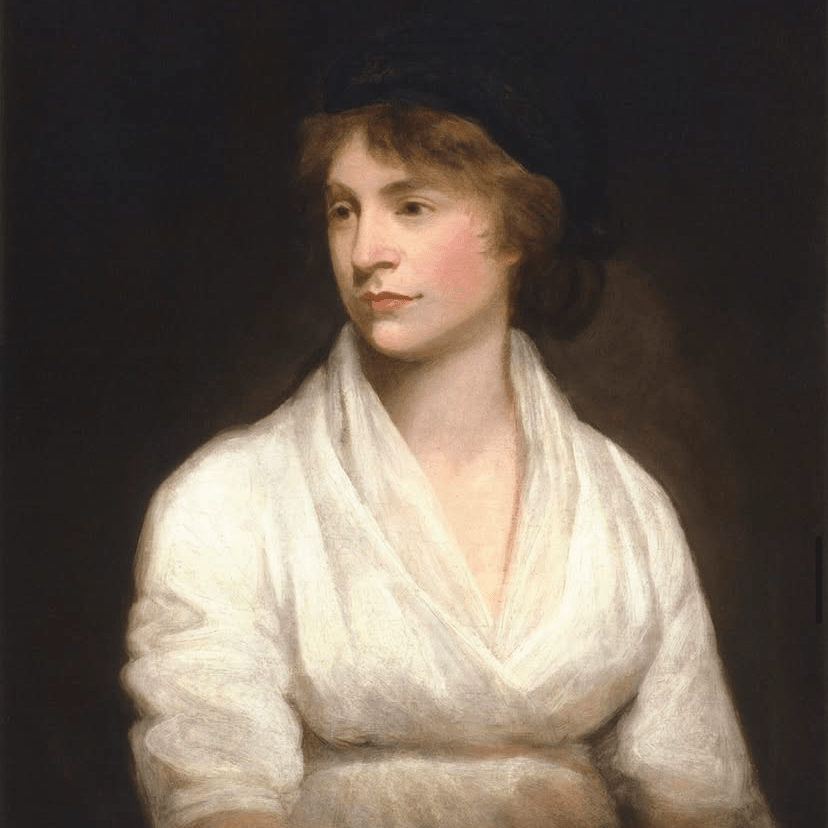
English writer and activist Mary Wollstonecraft was BOTD in 1759. Born in London to a farming family, her father was a violent alcoholic who squandered the family’s finances, and insisted that Mary forfeit her inheritance. As a teenager, she protected her mother from her father’s assaults, and persuaded her sister Eliza to leave her husband and infant son. She sought solace in an intense, romantically-charged friendship with Mary Arden, at one point writing, “I have formed romantic notions of friendship … I am a little singular in my thoughts of love and friendship; I must have the first place or none”. After briefly working as a ladies’ companion, she lived in the family home of her friend Fanny Blood. Wollstonecraft and Blood established a school as a means of supporting themselves, though the scheme failed after Blood married and became pregnant. A devastated Wollstonecraft moved to Yorkshire to work a governess, returning to London in 1788. She became a translator for the publisher Joseph Johnson, who published her novel Mary: A Fiction (based on her relationship with Blood) and Thoughts on the Education of Daughters, recounting her experiences as a governess. She became a literary celebrity in 1790 with the publication of A Vindication of the Rights of Men, her rebuttal of Edmund Burke’s pro-monarchist pamphlet Reflections on the Revolution in France. She followed this with her 1792 essay A Vindication of the Rights of Woman, in which she insisted on women’s equality with men and advocated for women’s education. After a disastrous affair with the married artist Henry Fuseli, she fled to Paris to observe the French Revolution. Having praised republicanism in theory, she was horrified by the savagery of the new regime, the brutal executions of King Louis XVI and Marie Antoinette, and the Jacobins’ chauvinist views towards women. Prevented from leaving France, she had an affair with American businessman Gilbert Imlay, with whom she had a daughter, Fanny. Imlay quickly left for London, promising to return, but left Mary and Fanny destitute. A year later, Mary returned to London in search of Imlay, who rejected her, prompting her to attempt suicide. She gradually returned to the London literary scene, meeting Johnson’s celebrity clients William Blake and William Wordsworth. She fell in love with the journalist William Godwin, and became pregnant to him. They married in March 1797, largely to legitimise her pregnancy, and lived separately in nearby apartments, allowing them to live and work independently. Wollstonecraft died of sepsis in September 1797, ten days after giving birth to her daughter Mary. She was 38. Now hailed as a pioneer of women’s rights, her writings inspired subsequent generations of feminists, including Elizabeth Cady Stanton, Susan B. Anthony, Margaret Fuller, Virginia Woolf and Simone de Beauvoir. Her daughter Mary was raised by Godwin, and became famous as the author of the novel Frankenstein.
Mary Wollstonecraft

 Super Gays Born on this Day