
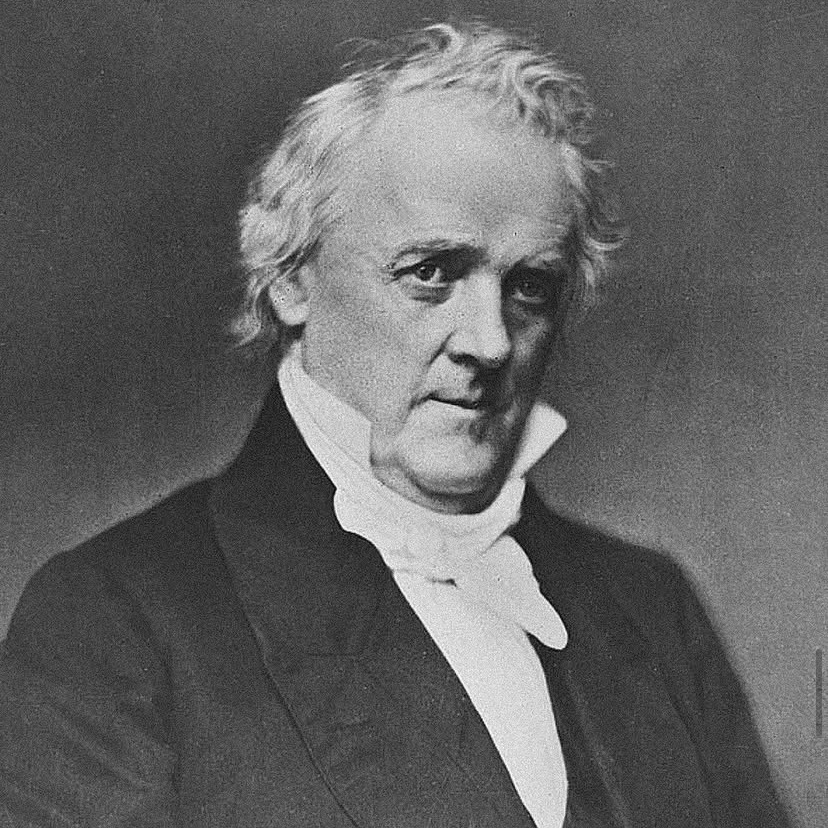
American politician James Buchanan was BOTD in 1791. Born in Mercersburg, Pennsylvania to Scots-Irish immigrants, he was educated at Dickinson College before training as a lawyer. He established a successful legal practice, before his talents in oratory led him to politics. Aligning himself with the emerging Democratic Party, he was elected to the Pennsylvania legislature in 1814 and became a Senator in 1821. He served in the administrations of Presidents Andrew Jackson, James Polk and Franklin Pierce, attempting to broker a compromise between Southern slave-owning and Northern free states, and supported the conquest of Cuba from the Spanish. In 1856, he was elected President. His efforts to secure the Union between North and South saw him suppress anti-slavery demonstrations, while supporting the Fugitive Slave Act (allowing the capture and return of escaped slaves to their former owners) and the legalisation of slavery in Kansas. His administration fell apart in 1860 after slave-owning South Carolina seceded from the Union, pushing the country into war. He retired from public office in 1861, just two months before the outbreak of the American Civil War. His remaining years were spent tacitly supporting the Union and attempting to defend his own disastrous presidency. A supporter of the Union and the war effort, he also opposed President Abraham Lincoln‘s 1863 proclamation freeing all American slaves. A lifelong bachelor, Buchanan had a long and intimate friendship with Congressman William Rufus King, with whom he lived for 14 years. Mockingly referred to as “Miss Nancy and Aunt Fancy” and “Siamese twins” by their detractors, biographers and historians are generally agreed that their relationship had a romantic dimension, though debates still rage over whether they were lovers. Buchanan died in 1868, aged 77.
James Buchanan

 Super Gays Born on this Day