
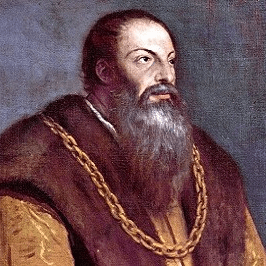
Italian writer and blackmailer Pietro Aretino was BOTD in 1492. Born in Arezzo in the Republic of Florence to a working class family, his father abandoned the family to join the army. His mother formed a relationship with a Perugian nobleman Luigi Bacci, who raised Pietro and his siblings as members of his family. Initially intending to be a painter, he was sent to Rome, earning the patronage of banker Agostino Chigi. In 1516, he wrote a series of pamphlets viciously criticising Pope Leo X, which made him instantly famous, launching his career as a satirist. In 1524, he wrote his Sonetti Lussuriosi (Lewd Sonnets) to accompany Giulio Romano’s pornographic drawings. The scandal caused by their publication, together with death threats and assassination attempts, forced him to leave Rome in 1527, relocating to Venice. Safe from the influence of the church, he continued writing poems, plays and commentaries, earning the nickname Il lagello dei principi (“the scourge of princes”). He became an expert blackmailer, extorting money from nobles who feared being targets of his satire. He is thought to have been paid simultaneous pensions from King Francis I of France and the Holy Roman Emperor Charles V, each hoping that Aretino would reveal damaging secrets about the other. Wealthy and famous, he lived lavishly, becoming close friends with the painter Titian and collecting and trading art. Titian painted his portrait three times, and frequently used him as a model, notably portraying him as Pontius Pilate in his painting Ecce Homo. Aretino enthusiastically commissioned portraits from painters including Giorgio Vasari and Jacopo Tintoretto. In 1545, he wrote an open letter to Michelangelo criticising the nudity in The Last Judgment, possibly in an attempt to extort a valuable artwork from the painter. Rumours circulated that Michelangelo painted Aretino as Saint Bartholomew in The Last Supper in an attempt to placate him, though this has been discredited by art historians. Declaring himself a sodomite since birth, Aretino pursued affairs with men and boys, once asking the Duke of Mantua to intercede on his behalf with a handsome young man named Bianchino. He died in 1556, aged 64.
Pietro Aretino

 Super Gays Born on this Day