
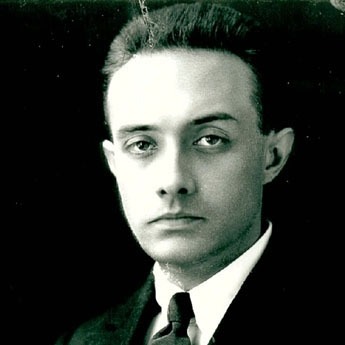
French writer Henry de Montherlant was BOTD in 1895. Born in Paris to an aristocratic family of Catalan origin, he developed an early interest in literature and art. At secondary school, he developed an intense crush on his schoolmate Philippe Giquel, and was eventually expelled for being “a corrupter of souls”. His relationship with Giquel became a lifelong obsession, recounted in his 1920 novel La Relève du matin (The Morning Shift). He rose to prominence with his 1934 novel Les Célibataires (The Bachelors). Between 1936 and 1939, he published a tetralogy of novels, Les Jeunes Filles, about a libertine novelist and his adoring female victims, selling over a million copies. Hailed by Georges Bernanos and André Gide as France’s greatest living writer, Montherlant’s misogyny was extensively critiqued by Simone de Beauvoir in The Second Sex. He travelled extensively through Spain, Italy and Algeria throughout the 1930s, engaging in paid sex with local boys and young men. He remained in Paris during World War Two, working as a war correspondent. A supporter of the German occupation of France, he wrote a series of essays praising the masculinist superiority of the Nazi militia and claiming that the French had been justly defeated. After the liberation of France, he avoided imprisonment for being a Nazi collaborator but was banned from publishing for a year. He shifted his focus to theatre, writing a series of historical dramas in which his stoic protagonists strive to hold to their self-inflated ideals. As literary censorship was liberalised, he explored pederastic themes in his play La Ville dont le prince est un enfant (The City Whose Prince is a Child) and revived a manuscript first written in the 1920s, published as Les Garçons (The Boys). In 1960, he was elected to the Académie-Française. He was assaulted by a group of young men outside a cinema in 1968, reputedly after he had attempted to grope one of them, leaving him partially blind. Faced with losing his eyesight and his reputation, he committed suicide in 1972, aged 77. After his death, his friend Roger Peyrefitte published his correspondence with Montherlant, outing him as a pederast. Still a controversial figure in France, his work was a major influence on German filmmaker Rainer Werner Fassbinder, notably in his films Das kleine Chaos (A Little Chaos) and Satansbraten (Satan’s Brew).
Henry de Montherlant

 Super Gays Born on this Day