
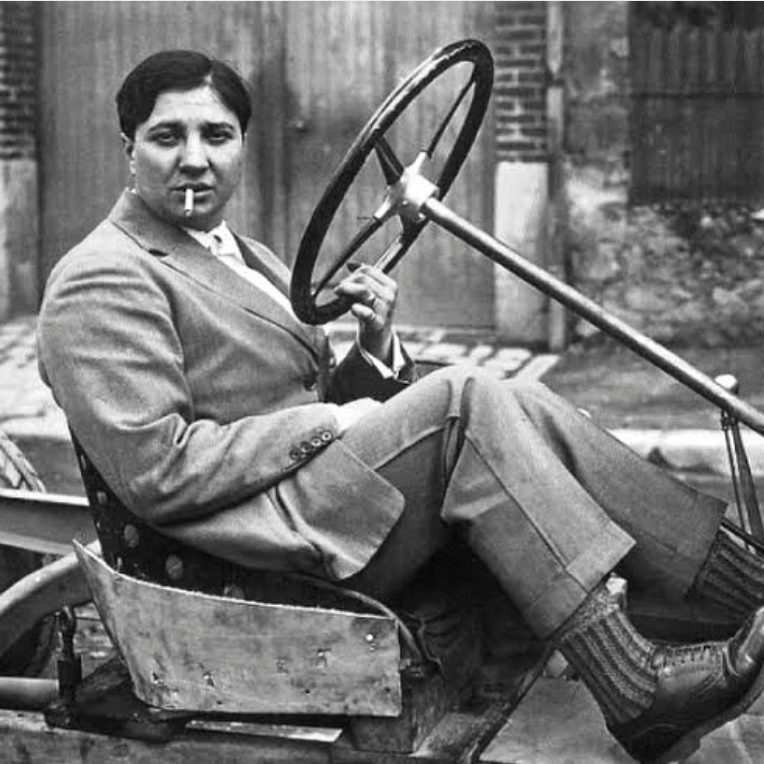
French athlete and Nazi collaborator Violette Morris was BOTD in 1893. Born in Paris, she was the sixth daughter of French Army captain Baron Pierre Morris and the Palestinian heiress Élisabeth Marie Antoinette Sakakini, Privately educated in a convent school, she excelled at boxing, javelin, shot put and swimming. In 1914, aged 20, she married Cyprien Gouraud, in what appears to have been an arranged marriage; the relationship was childless and ended in divorce. During World War One, she became an ambulance driver, working as a courier at the front lines of battle at the Somme and Verdun. After the war, she became a professional sportswoman, participating in football, water polo, athletics, boxing (often fighting men), bicycle motorcycle and car racing, horseback riding, tennis, archery, diving, swimming, weightlifting, Greco-Roman wrestling and airplane racing and winning multiple gold medals at the Women’s Olympiads. Openly lesbian, she typically dressed in men’s clothes, smoked cigarettes, swore in public and reportedly had her breasts removed to enable her to fit into racing cars more easily. She became a celebrity in 1920s Paris society, partying with Jean Cocteau and Jean Marais, had an affair with cabaret star Josephine Baker and a longer relationship with the actress Yvonne de Bray. In 1928, the French Women’s Sports Federation banned her from competing in the Paris Olympics, citing her “immoral” behaviour. She unsuccessfully sued the Federation for damages, claiming she was prevented from making a living as a sportswoman. In 1936, she was invited by Hitler to attend the Berlin Olympics as an honoured guest. The following year, she shot and killed an intruder on the houseboat she shared with de Bray. Tried for homicide, she was acquitted after the jury accepted her plea of self-defence. During World War Two and the German occupation of France, Morris collaborated with the Nazis and the Vichy government, earning her the nickname “Hyena of the Gestapo”. The exact nature of her involvement remains unclear, and rumours of her torturing members of the French Resistance have been disputed by historians. In 1944, she was shot dead by Resistance fighters while driving her Citroën from Lieurey to Épaignes. Her bullet-ridden body was abandoned at a morgue for several months, before being buried in an unmarked communal grave. She was 51. Her life has inspired historical novels by Francine Prose and Gérard de Cortanze.
Violette Morris

 Super Gays Born on this Day