
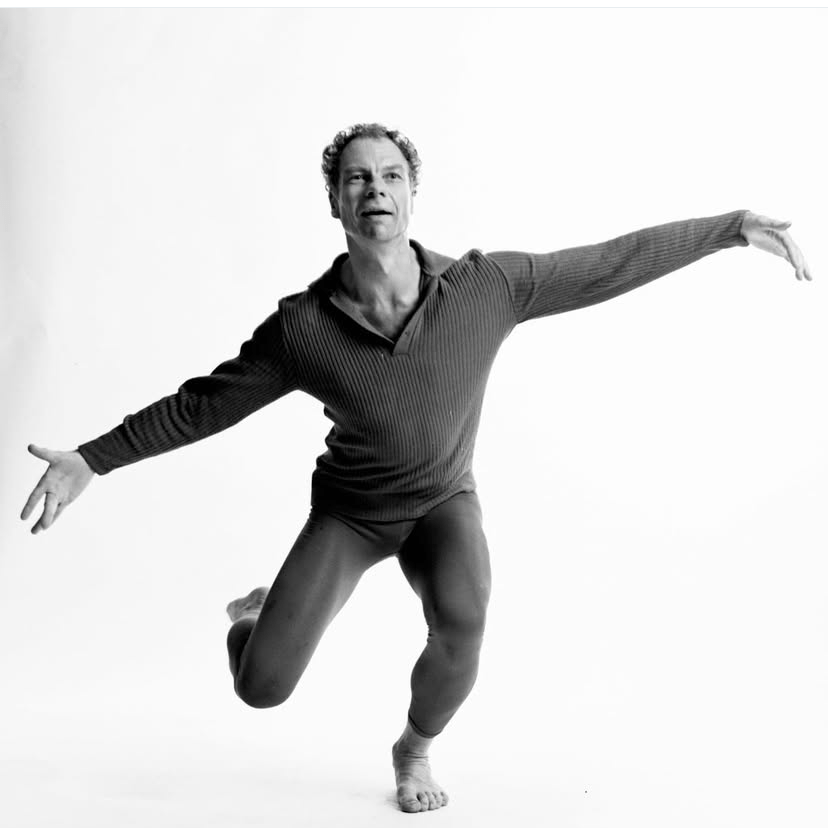
American dancer and choreographer Mercier (Merce) Cunningham was BOTD in 1911. Born in Centralia, Washington to a prominent middle-class family, he became interested in dance from an early age, taking tap dance lessons at 12. Resisting the family tradition to study law, he studied acting at the Cornish School of Fine and Applied Arts for two years before returning to dance, studying at Mills College and Bennington College. While at Bennington, he was invited by star choreographer Martha Graham to join her dance troupe. As soloist for the Martha Graham Dance Company, he created many important roles, and his impressive jumps were showcased in El Penitente, Letter to the World and Appalachian Spring. Encouraged by Graham, he began creating his own pieces, including Root of an Unfocus and Mysterious Adventure. In 1944, he began a relationship with composer John Cage, living briefly in a menage-a-trois with him and Cage’s wife Xenia Kashevaroff. Cage and Kashevaroff separated in 1945 and he and Cunningham became one of the power couples of the post-World War Two avant-garde, mixing with Max Ernst, Peggy Guggenheim, Piet Mondrian, Marcel Duchamp and Jackson Pollock. Cunningham presented his first solo concert in 1944, with music by Cage, and formed his own dance company in 1953. Cage wrote a number of compositions for Cunningham’s dance pieces, most famously Cheap Imitations, based on a musical theme of Erik Satie. Like Cage, Cunningham was interested in the potential of chance as a compositional tool. In his pieces Sixteen Dances for Soloist, Company of Three and Suite by Chance, he developed “choreography by chance”, in which isolated movements were sequenced by random methods such as tossing a coin. He was the first choreographer to work with electronic music, creating Suite by Chance to an electronic score by Christian Wolff. His 1953 piece Collage, performed to Pierre Schaeffer and Pierre Henry’s music made from tape-recorded environmental sounds, is thought to be the first American performance of musique concrète. He frequently collaborated with artists from other disciplines, including musician Brian Eno, graphic artists Robert Rauschenberg, Andy Warhol, Roy Lichtenstein and Jasper Johns and fashion designer Rei Kawakubo. In later life, Cunningham incorporated film into his dance pieces, notably Duets, Fielding Sixes, Channels/Inserts and Quartets. After Cage’s death in 1992, he continued to lead his dance company until shortly before his own death in 2009, aged 90. Now heralded as the father of 20th century modern dance, his career was the subject of the 2019 documentary Cunningham.
Merce Cunningham

 Super Gays Born on this Day