
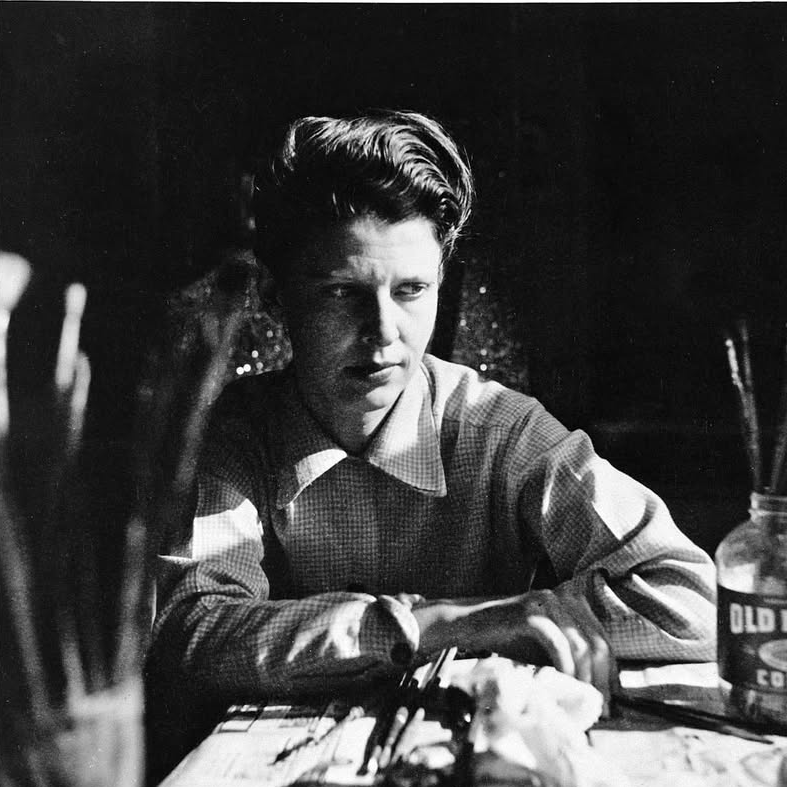
Swiss-born American artist Sonia Sekula was BOTD in 1918. Born in Lucerne, she attended elite boarding schools in Switzerland, In 1936, she studied painting in Florence, where she had an affair with photo-journalist Annamarie Schwarzenbach. Later that year, she moved with her family to New York City, where she studied at Sarah Lawrence College and the Art Students League. She befriended curator and philanthropist Peggy Guggenheim, who hosted her first solo exhibition in 1946. Though associated with the Abstract Expressionist and Surrealist movements, she refused to adhere to a singular style, drawing inspiration from African and Native American tribal art. Best known for her small-scale works, she applied paint delicately, avoiding the bold strokes and splashes utilised by Jackson Pollock and Willem de Kooning. Openly lesbian since her teens, her unashamed acknowledgement of her sexuality created ripples in the macho (and homophobic) American art scene. She had a series of unhappy affairs with fellow artists Alice Rahon and Manina Thoeren, though had more success with platonic friendships, living with gay composer John Cage and choreographer Merce Cunningham and creating costumes for Cunningham’s dance piece Dromenon. Sekula struggled with mental illness throughout her life, including multiple suicide attempts, and was repeatedly hospitalised by her parents. Unable to afford medical treatment in the United States, she and her family returned permanently to Switzerland in 1955. She continued working in relative obscurity, working as a bookkeeper to support herself. She committed suicide in 1963, aged 45. Largely forgotten after her death, her reputation was salvaged following Nancy Foote’s 1971 article Who Was Sonia Sekula?, leading to a major reappraisal of her work.
Sonia Sekula

 Super Gays Born on this Day