
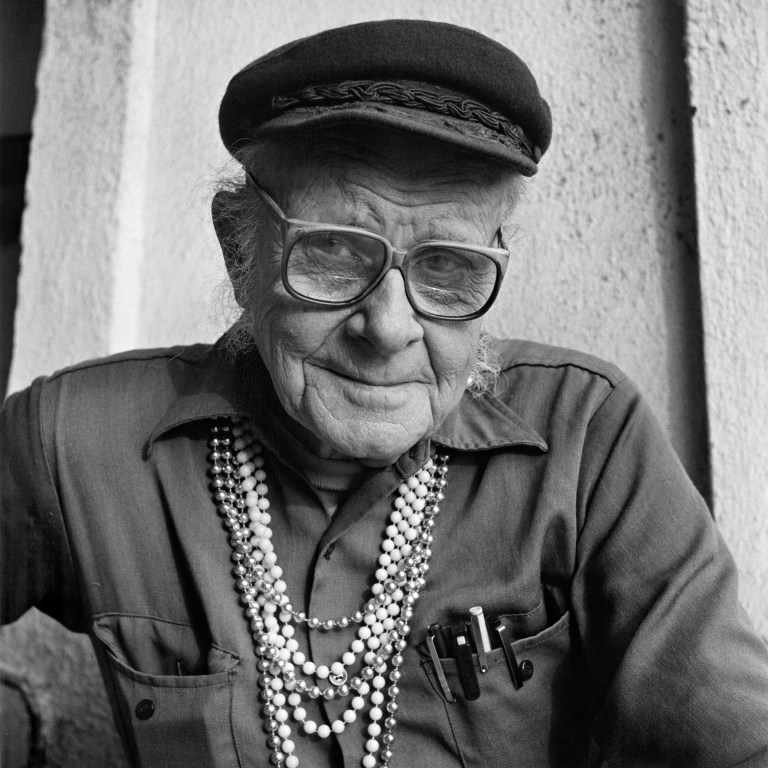
American activist Harry Hay was BOTD in 1912. Born in Worthing, England, his family moved to California when he was a child. He studied at Stanford University, though left in 1932 for health reasons. A committed Marxist, he was prevented from joining the US Communist Party due to its opposition to homosexuality. He entered into a marriage of convenience with Anita Platky in 1938, moving together to New York to support the Leftist organisation Popular Front, where he met and had a two-year relationship with actor Will Geer. After reading Alfred Kinsey’s 1948 study Sexual Behavior in the Human Male, Hay planned a political organisation to unite America’s underground homosexual culture and lobby for civil rights. His essay The Homosexual in America, published in 1951 under a pseudonym, argued that homosexuals were a culturally “oppressed minority”, drawing (controversial) comparisons with racial minorities. Together with Chuck Rowland and Bob Hull, he established the Mattachine Society, an organisation to raise awareness of discrimination against homosexuality. It quickly attracted thousands of members, and published ONE Magazine, the first widely distributed journal about homosexuality. Hay left the Society in 1953, dissatisfied with its leadership’s preference for assimilating into heterosexual society. After being subpoenaed to appear before the House Un-American Activities Committee in 1955, he kept a low profile over the next decade, entering into a relationship with the inventor John Burnside. Re-emerging into public life in 1969, Hay established the Los Angeles chapter of the Gay Liberation Front, advocating a radical, anti-assimilationist approach to gay rights. He and Burnside moved to New Mexico in 1970, where they developed an interest in Native American religions, inspiring them to co-found the gay spiritual network The Radical Faeries. Hay’s advocacy for pro-pederasty group the North American Man-Boy Love Association was highly controversial, alienating him from mainstream gay politics and leading to his ban from many Gay Pride marches. He was also highly critical of HIV-AIDS protest group ACT-UP, arguing that their confrontational tactics echoed the machismo of straight men. In later life, he aligned himself with anti-apartheid, nuclear disarmament and pro-abortion causes, and became a vocal critic of Presidents Ronald Reagan and George W. Bush. After suffering ill health, he and Burnside moved to San Francisco in 1999, where Hay was invited to be Grand Marshall of the San Francisco Gay Pride parade, widely viewed as a tribute to his decades of activism. He died in 2002 of complications from lung cancer, aged 90.
Harry Hay

 Super Gays Born on this Day