
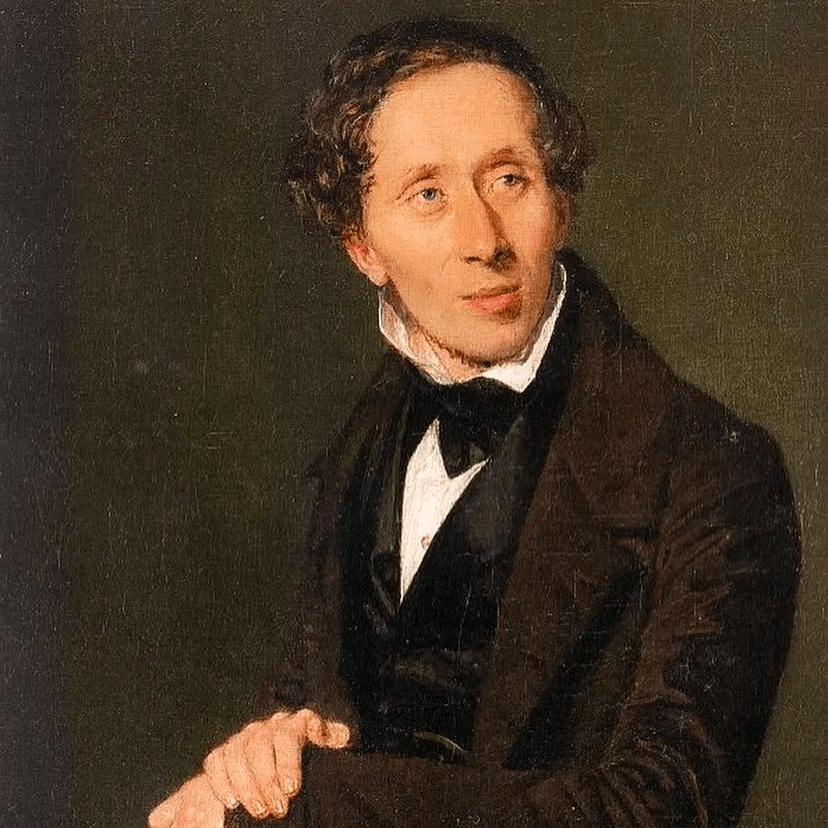
Danish writer Hans Christian Andersen was BOTD in 1805. Born in Odense, he had a turbulent childhood, raised in a brothel and supporting himself as a tailor before being accepted into the Royal Danish Theatre. After his singing career fell flat, he pursued a writing career, finding limited success with his early short stories, poems and plays. He became an international celebrity with the publication of his Fairy Stories for children, first published in 1835 and illustrated with his own woodcuts. Partially based on Norse folktales, his stories The Emperor’s New Clothes, The Little Mermaid, The Princess and the Pea, Thumbelina and The Little Match Girl were praised for their careful construction, ironic humour and haunting depictions of poverty and cruelty towards children. His work had a major influence on the development of children’s literature, and its popularity as a literary genre. He became an international celebrity, and was granted an annual stipend from the King of Denmark. Horribly shy and afflicted with a stutter, he often alienated friends, including the novelist Charles Dickens, whom he stayed with for five weeks, driving the household insane until Dickens asked him to leave. Though terrified of sex, he developed an obsessive crush on Swedish opera singer Jenny Lind (to whom he dedicated the story The Nightingale) and on his friend Edvard Collin. Andersen’s heartbreak over Collin’s marriage to a woman inspired Andersen’s story The Little Mermaid, a harrowing tale about a mermaid who transforms into human form for the love of a human man who later rejects her. Andersen had marginally more successful relationships with Carl Alexander the Duke of Saxe-Weimar-Eisenach and the ballet dancer Harald Scharff (who inspired the story The Snowman). He died in 1875 aged 70. Still one of the world’s most read and translated writers, his stories have been frequently dramatised and reworked. In recent years, academics have parsed the queer subtext of Andersen’s stories, typically featuring outcasts and unhappy lovers, abandoned by an uncaring world and desiring to change their secret and loathed true natures. He was played by Danny Kaye in a queer-washed 1952 Hollywood musical biopic.
Hans Christian Andersen

 Super Gays Born on this Day