
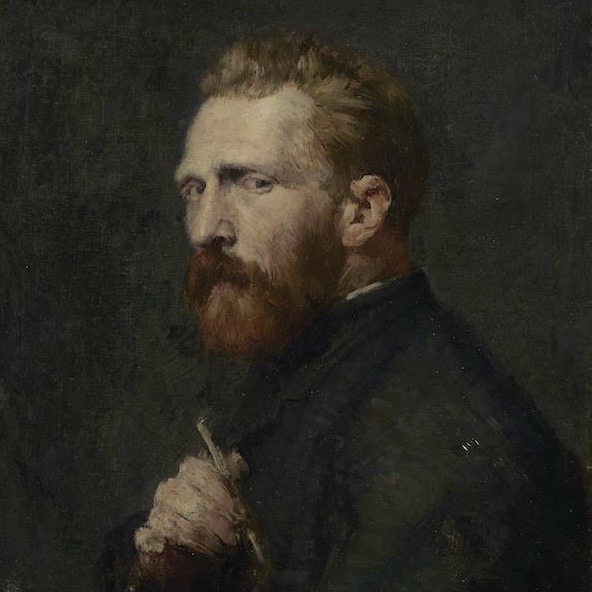
Dutch painter Vincent van Gogh was BOTD in 1853. Born in Zundert in the Netherlands to an upper middle-class family, he was apprenticed as a teenager to art dealers in The Hague, working in their London and Paris branches. After unsuccessful attempts at missionary work and studying theology, he studied drawing at the Brussels Academy, returning to the Hague to work with landscape painter Anton Mauve. In 1886, he moved to Paris at the invitation of his art dealer brother Theo, who became his closest friend and financial supporter. Through Theo, he met Post-Impressionist painters Henri de Toulouse-Lautrec and Paul Gauguin, developing a bolder and more abstract style inspired by Japanese painting, using vivid blocks of colour, heavy brushstrokes and claustrophobic framing. He left Paris in 1888 for Arles in southeastern France, creating over 200 paintings of blossoming fruit trees, rural landscapes, village buildings, portraits of himself and friends, sunflowers, and cypress trees. Gauguin visited him in the autumn, where they continued their intense, erotically-charged friendship, influencing each other’s work while disagreeing about the purpose of art. On Christmas Eve, they had a violent argument – possibly ignited by Gauguin rejecting van Gogh’s romantic advances – resulting in Gauguin mutilating van Gogh’s ear with a sword. Gauguin’s biographers have speculated that the two men concocted the story about van Gogh mutilating his own ear to spare Gauguin’s reputation and buy his silence about van Gogh’s sexuality. In 1889, van Gogh entered an asylum but was encouraged by his doctors to continue his art, completing over 150 paintings and drawings. A move to Auvers-sur-Oise in 1890 was followed by another burst of artistic activity, but he suffered a relapse and died in July, apparently of a self-inflicted gunshot wound, aged 37. (Biographers have since speculated that he was not suicidal, but was instead wounded during a violent attack). Theo died soon after, leaving his wife Johanna in charge of managing Vincent’s estate. She became a champion of van Gogh’s Witi, making sales of his important pieces to London’s National Gallery and other galleries, and translating the brothers’ correspondence into English. After selling only one painting in his lifetime, van Gogh became one of the most popular painters in 20th century art, exerting a profound influence on the post-Impressionist and Modernist art movements. In 1987, one of his Sunflowers paintings sold at auction for £25 million, at the time the highest sum ever paid for a work of art. His reputation as a mad genius was repeated in innumerable biographies, critical studies, novels and plays, and bolstered by his numerous screen portrayals, notably Kirk Douglas in Lust for Life, Tim Roth in Vincent and Theo, Jacques Dutronc in Van Gogh and Willem Dafoe in At Eternity’s Gate. The Van Gogh Museum in Amsterdam, opened in 1973, has sought to challenge this stereotype, showcasing van Gogh’s precise technique, sophisticated understanding of perspective and his insight into his own creative process, eloquently described in his letters to Theo.
Vincent van Gogh

 Super Gays Born on this Day