
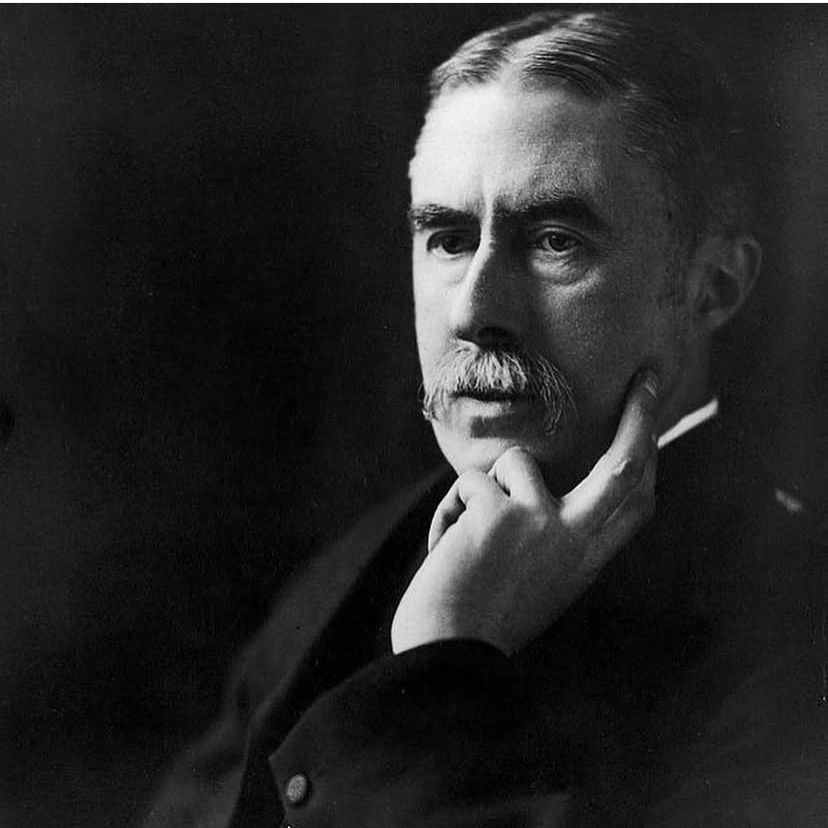
English poet and scholar Alfred Edward (A. E.) Housman was BOTD in 1859. Born in Bromsgrove, Worcestershire, he was a gifted student, winning a scholarship to study classics at Oxford University. He fell passionately in love with his roommate Moses Jackson, neglecting his studies and failing his exams. Leaving Oxford for London, he worked as an office clerk, sharing a house with Jackson’s brother Adalbert, though parted after Adalbert declared he could not reciprocate Housman’s romantic feelings. Housman pursued his classical studies independently, publishing scholarly articles and translations of Classical Greek and Roman texts. He was offered a professorship in Latin at University College London, and later at Cambridge University, where he remained for the rest of his life. He is best known for his poetry cycle A Shropshire Lad, published at his own expense in 1896. Set in an idealised English pastoral, the poems’ elegiac lament for lost youth and preoccupation with death became hugely popular in Edwardian England, and were set to music by composers including Arthur Somervell, Ralph Vaughan Williams and Samuel Barber. Housman’s popularity increased after World War One, as war-torn England reminisced about its lost years, prompting him to publish a further volume, Last Poems, in 1922. Closeted for most of his life, Housman was relatively open about his homosexuality in his poems, notably “Because I liked you better / Than suits a man to say / It irked you, and I promised / To throw the thought away”. Like many closeted queens, he wrote vicious comments about his literary critics, and intimidated his female students, forgetting their names and reducing them to tears. Described by a colleague as being “descended from a long line of maiden aunts”, he appears to have enjoyed himself overseas, visiting male brothels in Paris and having sex with Venetian gondoliers supplied by his friend Horatio Forbes Brown. He died in 1936 aged 77. His life and work was dramatised in Tom Stoppard’s 1997 play The Invention of Love, which imagines the elderly Housman looking back on his Oxford crushes and meeting Oscar Wilde in the afterlife.
A. E. Housman

 Super Gays Born on this Day