
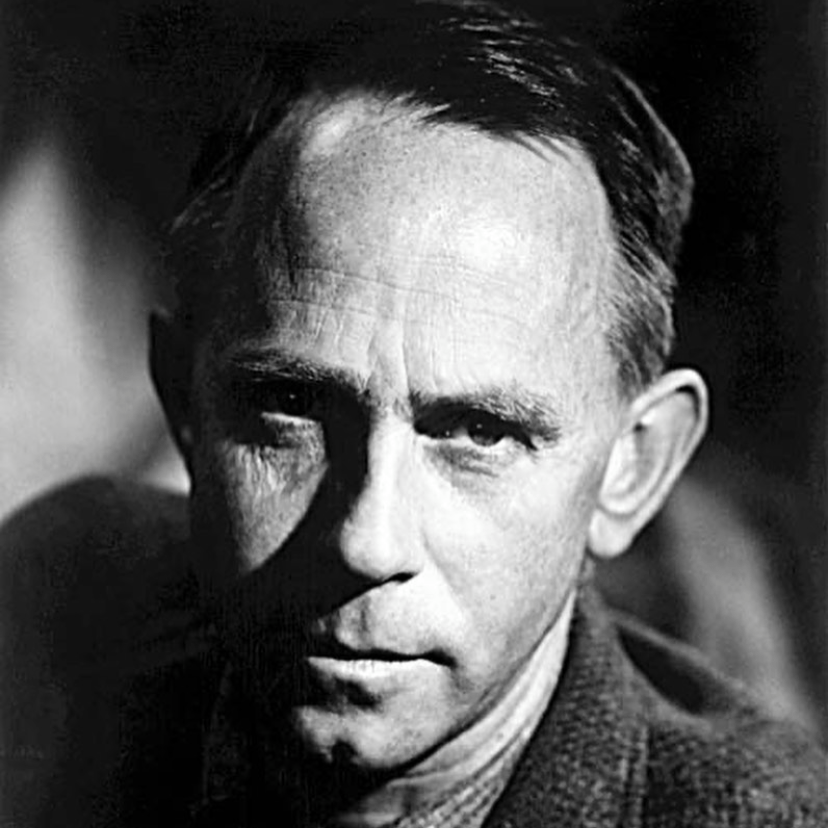
New Zealand writer Frank Sargeson was BOTD in 1903. Born Norris Davey in Hamilton to a middle-class family, he studied law at Auckland University College. After graduating, he travelled to Europe, where he had his first same-sex relationship. Returning to New Zealand in 1928, he worked at the Public Trust Office in Wellington. The following year, he was convicted of indecent assault after a sexual encounter with another man. He was given a suspended sentence and required to leave Wellington. After working on his uncle’s farm for 18 months, he moved to his family’s holiday home in Auckland, where he lived for the rest of his life, adopting the name Frank Sargeson. He began publishing stories in the 1930s, breaking with Anglocentric conventions by using informal New Zealand-accented English. Adopting an austere minimalist style, his narratives typically focused on isolated male characters in a rural landscape. He became the foremost fiction writer of his generation, encouraging the development of a vernacular New Zealand literature. He edited an influential collection of New Zealand short stories, Speaking for Ourselves, and mentored a number of younger writers, notably Janet Frame, who lived with him following her release from a psychiatric hospital. After a fallow period in the 1950s, his career flourished in the 1960s with collections of short stories, plays and novels, and won the 1965 Katherine Mansfield Memorial Award for his story Just Trespassing, Thanks. In the 1970s, he published a series of memoirs, avoiding any mention of his homosexuality (at the time still a criminal offence). He was in a discreet long-term relationship with Harry Doyle until the latter’s death in 1972. Sargeson died in 1982, aged 78, four years before homosexuality was legalised in New Zealand. Posthumously, several literary prizes and writing scholarships have been established in his honour.
Frank Sargeson

 Super Gays Born on this Day