
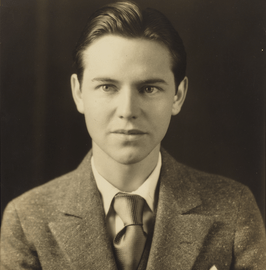
American writer, artist, editor and filmmaker Charles Henri Ford was BOTD in 1908. Born in Brookhaven, Mississippi to a prosperous Southern family, he was a gifted student, publishing poetry in the New Yorker magazine while still in his teens. He dropped out of high school and became an editor for the literary magazine Blues, where he met the writer and critic Parker Tyler. The two became lovers, moving to New York City together in 1930, and later to Paris, where they became part of Gertrude Stein‘s literary salon, socialising with Natalie Clifford Barney, Man Ray, Janet Flanner, Peggy Guggenheim and Djuna Barnes. Ford had an affair with writer Paul Bowles, visiting Tangiers and Morocco at his suggestion, where he somehow ended up typing the manuscript of Barnes’ novel Nightwood. In 1933, he and Tyler co-wrote The Young and Evil, an experimental novel about young bisexual artists in New York, written in homage to Barnes and Stein. American critics objected to its sexual content and it was banned in many states. The following year, Ford returned to New York with his lover, the Russian artist Pavel Tchelitchew, joining a largely homosexual social circle including Carl Van Vechten, Glenway Wescott, George Platt Lynes, Lincoln Kirstein, Orson Welles, George Balanchine, e. e. cummings, Cecil Beaton, Salvador Dalí and Tyler’s long-term partner Charles Boultenhouse. He published his first book of poetry, The Garden of Disorder, in 1938. Following Tyler’s return to New York, they co-founded and edited the avant-garde magazine View in 1940, commissioning contributions over the next seven years from writers Jorge Luis Borges, Henry Miller, Jean Genet and Albert Camus and artists Pablo Picasso, Max Ernst, Man Ray, Georgia O’Keeffe, Marc Chagall, Paul Klee and Joan Miró. After the war, Ford and Tchelitchew returned to Europe, where Ford exhibited his first one-man shows of photographs and paintings. After Tchelitchew’s death in 1957, Ford returned to New York, where he began associating with Andy Warhol and other Pop Art artists. He began directing experimental films, including 1971’s Johnny Minotaur, which caused controversy for its explicit homosexual content. He then moved to Kathmandu in Nepal, engaging a Nepalese teenager, Indra Tamang, as his live-in housekeeper and photographic assistant. They lived together in Paris and Crete before returning to New York City, continuing to collaborate on artistic projects. In 1992, Ford published an anthology of articles from View, and selections from his diaries, entitled Water from a Bucket, in 2001. He died in 2002, aged 94, survived by Tamang, who published his own memoirs in 2024.
Charles Henri Ford

 Super Gays Born on this Day