
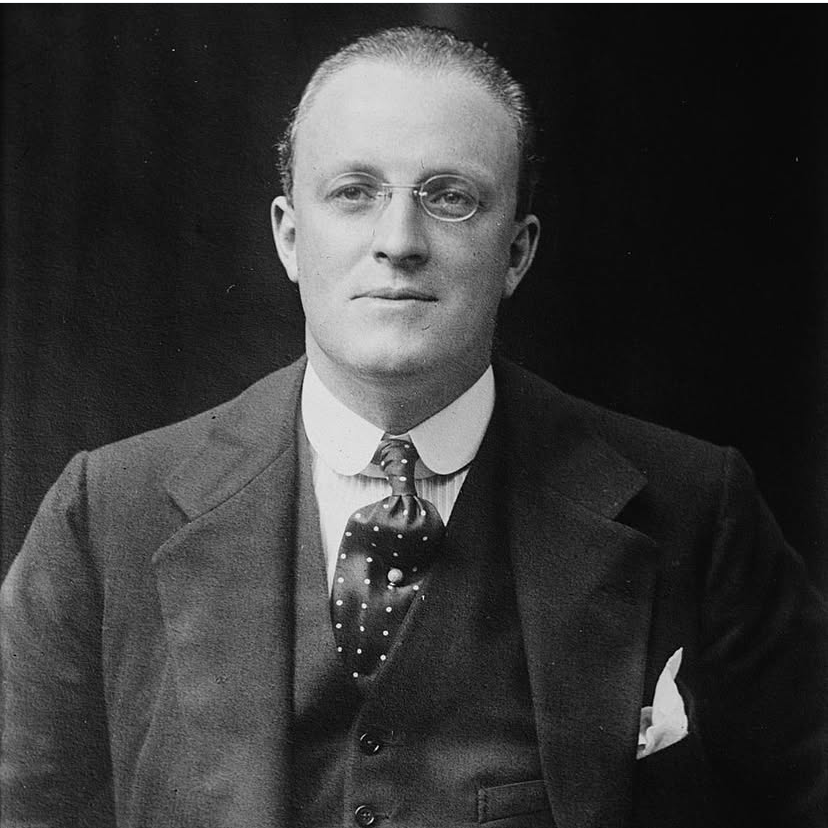
English journalist and novelist Hugh Walpole was BOTD in 1884. Born in Auckland, New Zealand (then part of the British Empire) where his father was an Anglican vicar, he was sent to England to be educated. He studied at Cambridge University, falling unrequitedly in love with his lecturer A. C. Benson, and chasing classmates including Edmund Gosse, H. G. Wells, Max Beerbohm and Robbie Ross. Rejecting his father’s plans for him to join the church, he embraced the life of a literary homosexual, publishing his first novel The Wooden Horse in 1909, followed by Mr Perrin and Mr Traill, a chaste fictionalising of his friendship with Benson. He had a long erotically-charged friendship with American novelist Henry James, whom he called “my very dear Master”, though failed to get the prudish James into bed. During World War One, he became a foreign correspondent in Russia, working in field hospitals on the front lines and rescuing wounded soldier from battlefields. He settled in Petrograd, working for British intelligence and immersing himself in the literary scene, and had a live-in relationship with Russian artist Konstantin Somov. His Russian-themed novel The Dark Forest won the inaugural James Tait Black Prize. After the war, he became well known as a lecturer, undertaking successful tours in Europe and the United States. A dedicated Wagner fan, he became the patron of tenor Lauritz Melchior and regularly attended the Bayreuth Festival, where he met Hitler and fended off the amorous advances of Wagner’s sister. He befriended Virginia Woolf and other members of the Bloomsbury Group, and testified in defence of Radclyffe Hall in the obscenity trial for her novel The Well of Loneliness. He moved to the Lake District, where he met Harold Cheevers, a married policeman who became his chauffeur and lover. He also had a brief career in Hollywood, writing the screenplay for MGM’s 1935 film of David Copperfield in which he had a cameo part as a vicar. In 1939, he reported on the funeral of Pope Pius XI, managing a quickie with a palace attendant en route. He died in 1941 aged 57, bequeathing his impressive collection of modern art to the Tate Gallery.
Hugh Walpole

 Super Gays Born on this Day