
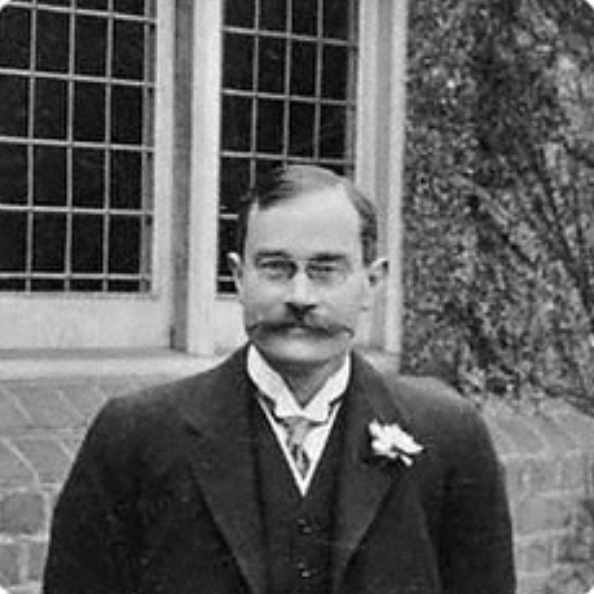
English psychiatrist William Halse Rivers (W. H. R.) Rivers was BOTD in 1864. Born in Kent to a middle-class family with naval connections, he struggled with a childhood stammer, but excelled academically. After missing out on university due to illness, he studied medicine at the University of London and St Bartholomew’s Hospital, graduating as a doctor at 22. Turned down for military service due to ill health, he worked as a ship’s surgeon, travelling the world for several years. Returning to a position at St Bartholomew’s Hospital in London, he developed an interest in psychology and neurology, at the time not widely understood or accepted in medical practice. He began researching nervous disorders, and was offered a research position at Cambridge University, where he pioneered the use of double-blind procedures in scientific research. He is best known for his work with shell-shocked soldiers during World War One, based at Craiglockhart War Hospital near Edinburgh. Inspired by the writings of Sigmund Freud and Carl Jung, he theorised that shell-shock was not insanity but an attempt to repress traumatic war experiences. He popularised the talking-cure to help his patients, putting him at odds with colleagues who prescribed electric shock treatment. Rivers’ most famous patient was the poet Siegfried Sassoon, whom he encouraged to write as part of his therapy. Discreetly gay, Rivers also helped Sassoon accept his own homosexuality. Sassoon’s letters and diaries reveal his infatuation with Rivers as the “dream friend” of his childhood fantasies. Their relationship, while loving, was never consummated. After the war, Rivers joined the Labour Party, intending to run for Parliament. He died suddenly in 1922 of a strangulated hernia, aged 58. His work at Craiglockhart and relationship with Sassoon was a central part of Pat Barker’s Regeneration novel trilogy, published between 1991 and 1995. He has been portrayed by Jonathan Pryce in the 1997 film of Regeneration and by Ben Daniels in Terence Davies‘ 2021 Sassoon biopic Benediction.
W. H. R. Rivers

 Super Gays Born on this Day