
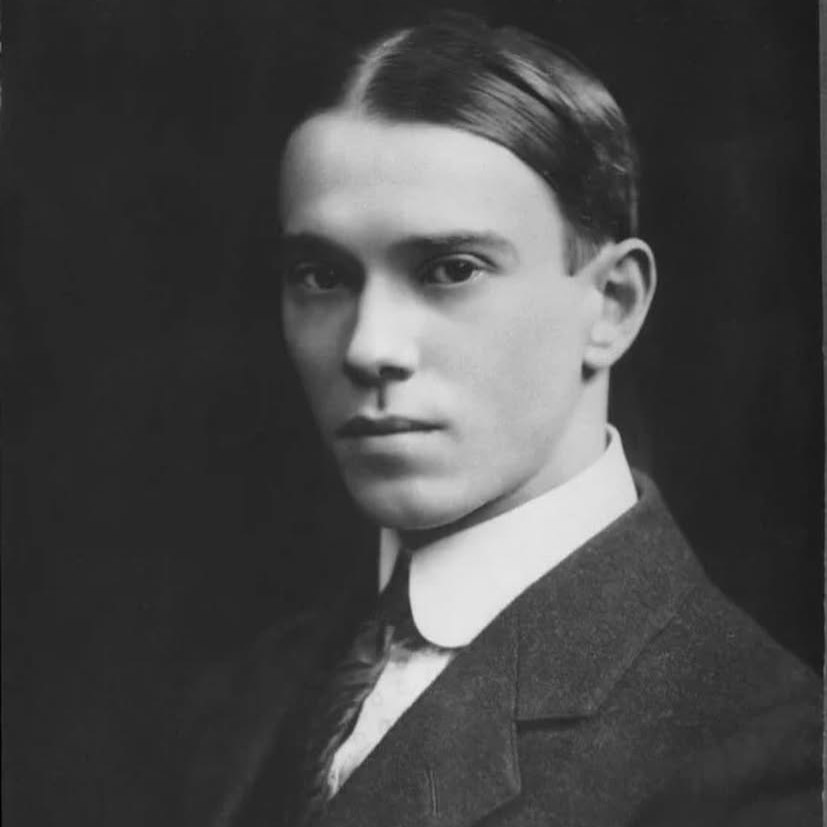
Ukrainian dancer and choreographer Vaslav Nijinsky was BOTD in 1890. Born in Kiev in Soviet Ukraine to Polish parents, he grew up in the Caucasus and entered the Imperial School of Dancing in St Petersburg aged eight. He became the star dancer of the Mariinsky Theatre, partnered with Anna Pavlova and Tamara Karsavina, hailed for his beauty, athleticism and gravity-defying leaps. In 1909, he became the protégé and lover of impresario Sergei Diaghilev, who made him the star of avant-garde ballet company the Ballets Russes. Nijinsky took Europe by storm, thrilling audiences with his homoerotically charged performances in Le Spectre de la rose, Schéhérazade and Petruskha. His 1912 performance as a horny faun in L’Après-midi d’un faune caused a scandal when he appeared to masturbate on stage. He is best known as the choreographer of Le sacre du printemps (The Rite of Spring), a dance drama with a score by Igor Stravinsky, depicting a pagan rite in which a young woman dances herself to death. Nijinsky matched the harsh atonal score with innovative choreography, disregarding classical technique with pigeon-toed flat-soled feet positioning and jerking staccato body movements. The 1913 premiere in Paris caused a riot as rival factions screamed their outrage and admiration, drowning out the orchestra and requiring Nijinsky to shout directions to the dancers from offstage. Proclaimed as a work of genius by celebrity attendees Carl Van Vechten, Jean Cocteau and Maurice Ravel, it is now considered the symbolic pinnacle of 20th century Modernism. The commercial failure of Printemps placed strain on Nijinsky’s relationship with Diaghilev, and he departed for a tour of South America. While travelling, he married Romola de Pulszky, an obsessed fan who insinuated her way into the company to get close to him. An infuriated Diaghilev dismissed Nijinsky from the company via telegram, replacing him with his younger protégés Mikhail Fokine and Léonide Massine. The Nijinskys settled in St Moritz, having two children together. Prevented by Diaghilev from performing his Ballets Russes repertoire, he struggled to find work and became increasingly mentally unstable. He gave his last public performance in 1919, before being diagnosed with schizophrenia. He spent the last 30 years of his life in and out of psychiatric institutions, dying in 1950, aged 60. Widely regarded as the greatest male ballet dancer of all time, his work and legend inspired generations of dancers and choreographers, notably Rudolf Nureyev, who matched him in talent and sexual charisma. Romola published his diaries in the 1930s, edited to remove references to his homosexuality; the unexpurgated versions were finally published in 1995. He has been portrayed many times on screen, notably by George de la Peña in the film Nijinsky and by Adam Garcia in Riot at the Rite. The 2009 film Coco Chanel & Igor Stravinsky begins with a recreation of the Paris premiere of Printemps, with Marek Kossakowski appearing briefly as Nijinsky.
Vaslav Nijinsky

 Super Gays Born on this Day