
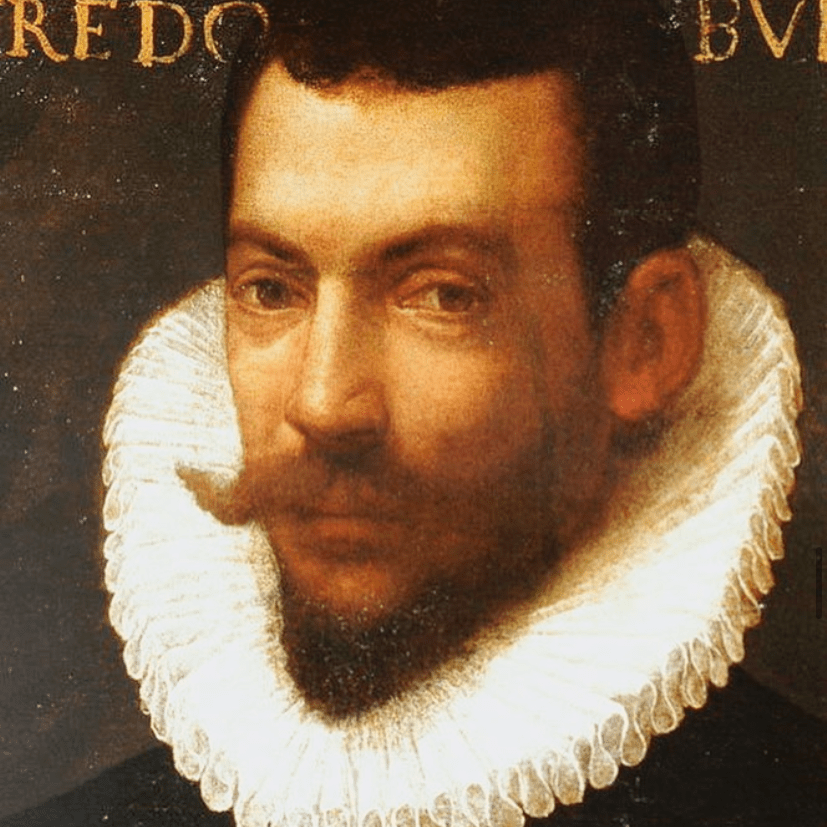
Italian poet Torquato Tasso was BOTD in 1544. Born in Sorrento to an aristocratic Neapolitan family, his father went to exile after being proclaimed an enemy of the state, and he was raised by his mother in Naples. He moved to Rome aged 8 to live with his father, and joined the court of the Duke of Urbino. Sent to study law in Padua, he devoted himself to poetry and philosophy, producing an epic poem Rinaldo in 1562. Its success launched his career, and he entered the service of Cardinal Luigi d’Este, where he published two books of love sonnets, apparently inspired by ladies-in-waiting from the court. A disagreement with the Cardinal caused him to leave, and he joined the court of the Cardinal’s brother, Duke Afonso of Ferrara. He completed the pastoral drama Aminta and his most important work Gerusalemme Liberata (Jerusalem Delivered), an epic poem based on the Crusades, notable for its many depictions of romantic love. Despite his success, he became increasingly paranoid, suspecting his servants and friends of trying to poison him. His persecution complex included some (justifiable) fears that his attraction to men would be discovered. In 1576, he wrote to a homosexual friend confessing his love for the 21 year-old Orazio Ariosto, and quarrelled with another friend for being too indiscreet about his sexual double life. He escaped from the Duke’s service in 1578, travelling on foot around Italy and living as a vagrant, before being confined in a mental asylum. He wrote copiously while imprisoned, and was released in 1586. After several miserable years, he was invited to Rome by Pope Clement VIII in 1595, who intended to crown him poet laureate. Tasso died on the journey, aged 51. His work was widely translated and read after his death, inspiring poets Philip Sidney, Edmund Spenser, Johann von Goethe, John Milton and Lord Byron. Jerusalem Delivered was set to music by every major composer of the 18th century, including Jean-Baptiste Lully, George Frideric Handel, Antonio Vivaldi, Gioachino Rossini, Gaetano Donizetti and Franz Liszt.
Torquato Tasso

 Super Gays Born on this Day