
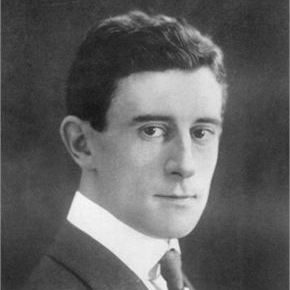
French composer Maurice Ravel was BOTD in 1875. Born in Ciboure near the Spanish border to a prosperous middle-class family, he was raised in Paris, and began studying piano when he was 7. He gave his first public performance at 14, and was admitted to the Conservatoire de Paris, where he studied with composer Gabriel Fauré. Ravel socialised with a largely gay coterie of young musicians and composers, including Richard Viñes and Manuel de Falla (both of whom were probably his lovers), Erik Satie and Reynaldo Hahn. His early compositions included the piano piece Jeux d’eau and the orchestral song cycle Shéhérazade. His work caught the eye of impresario Sergei Diaghilev, who commissioned him to write Daphis et Chloé for the Ballet Russes. Too short and poorly to become a soldier, he worked as a lorry driver for the French Army during World War One, causing the deterioration of his physical and mental health. His musical reputation soared during the 1920s, where he was hailed as France’s successor to Claude Debussy, and undertook successful tours of Europe and North America. He is best known for his orchestral piece Boléro, a rousing, stately dance piece inspired by his Basque childhood. Premiered in 1928 in Paris, where it was performed as a ballet, it became an immediate sensation, and has since become one of the most popular pieces of 20th century music. During the 1930s, he produced two piano concertos, including the Concerto in D major for the Left Hand, which became an immediate success. A car accident in 1932 brought his performance career to an end, leaving him partially paralysed and unable to write music. Shy and closeted, Ravel lived with his mother for most of his adult life, occasionally attending gay bars with friends Jean Cocteau and Francis Poulenc, and secretly collecting pornography, but appears to have had no significant relationships. He died in 1937 following experimental brain surgery, aged 62.
Maurice Ravel

 Super Gays Born on this Day