
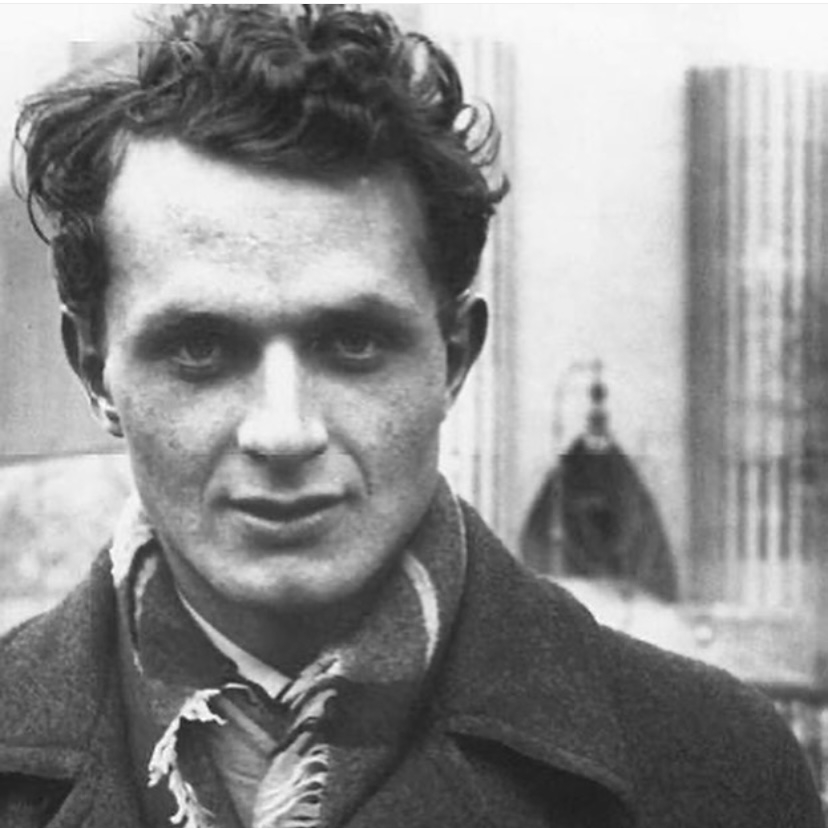
English writer Stephen Spender was BOTD in 1909. Born in London to an affluent middle-class family, he studied at Oxford University, where he befriended W. H. Auden and Christopher Isherwood and socialised with the Bloomsbury Group. In 1929, he moved to Hamburg, frequently visiting Isherwood in Berlin. His 1951 memoir World Within World described the sexual liberation of Weimar Republic-era Germany and the growing threat of Nazism. In 1993, he published his first poetry collection, edited by T. S. Eliot, with whom he had a long professional relationship. Increasingly involved in left-wing politics, he became a reporter during the Spanish Civil War, and was briefly imprisoned before returning to England, where he worked for the London Auxiliary Fire Service. He co-founded the literary magazines Horizon and Encounter, continuing to publish poetry, essays (many expressing his disillusionment with Communism) and translations of German and Russian writers. In the 1950s, he taught at a number of American universities, returning to England in 1961 to teach at Oxford and latter at University College London. A noted art critic, he collected and befriended artists including Pablo Picasso, Francis Bacon, Lucian Freud, Henry Moore, Alberto Giacometti and David Hockney, with whom he collaborated on the 1982 book China Diary. His relationship to his sexuality was complex and often contradictory. An Oxford homosexual in his youth, he had a four-year relationship with Tony Hyndman in the 1930s, and a short-lived marriage to Inez Pearn during his Communist period. In 1941, he married concert pianist Natasha Litvin, remaining together until his death. A founding member of the Homosexual Law Reform Society in the late 1950s, he edited out homosexual references in his poetry in later life. In 1994, he sued writer David Leavitt for breach of copyright, after Leavitt published a gay-themed novel inspired by Spender’s memoir World Within World. The resulting litigation effectively became his public coming-out. The following year, he allowed the publication of his 1929 novel The Temple, recounting his homosexual experiences as a young man in Berlin. He died in 1995 aged 86. His diaries, published posthumously, revealed his sexual encounters with men before and during his marriage.
Stephen Spender

 Super Gays Born on this Day