
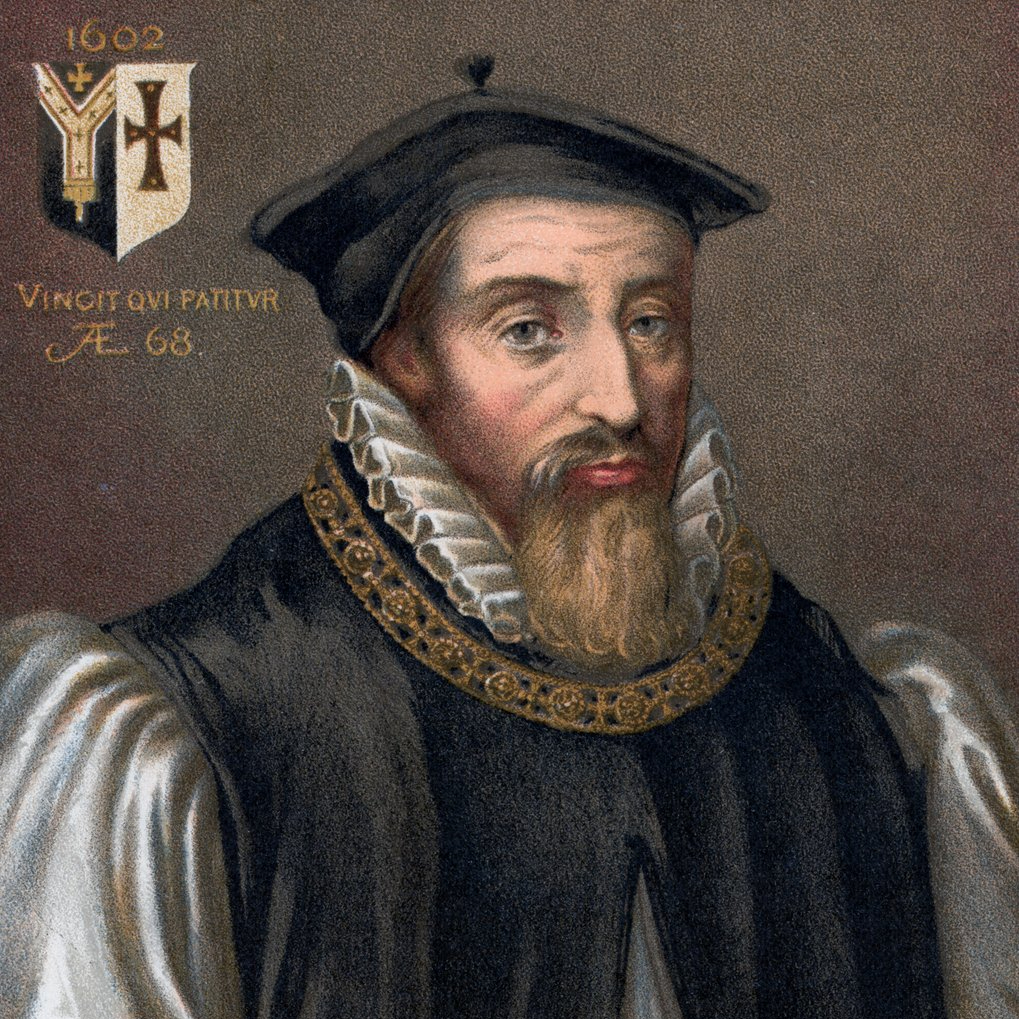
English cleric John Whitgift was born in c. 1530 and died on this day [29 February] in 1604. Born in Great Grimsby, Lincolnshire to a prosperous merchantile family, he was educated at Cambridge University. Raised in the newly-formed Church of England, he witnessed the religious persecutions of Protestants during the reign of Queen Mary, though managed to avoid execution as a heretic. In 1560, two years after the accession of the Protestant Queen Elizabeth I, he was ordained as a priest in the Church of England, becoming chaplain to the Bishop of Ely. He became a divinity professor at Cambridge in 1563, impressing a younger generation of students including Sir Francis Bacon. After rising through church hierarchy, he was appointed Archbishop of Canterbury in 1583. An enthusiastic adopter of Elizabeth’s policy of religious uniformity, he prosecuted Puritan clerics, drew up articles censoring non-conforming clergy and stamped out the publication of “heretical” religious tracts. He became one of Elizabeth’s closest confidantes, attending her on her deathbed, and continued in office during the early years of James I‘s reign. Whitgift had a long-term friendship (and probable romantic relationship) with university vice-chancellor Andrew Perne, eventually moving Perne into Lambeth Palace after he became Archbishop of Canterbury. The two were so inseparable that Puritans mockingly called Whitgift “Perne’s boy” who was willing to “carry his cloak-bag”, insinuating that they were lovers. Whitgift attended the first Hampton Court Conference in 1604 to discuss the revision of the Church’s official prayer book, and died a month later, aged 73 or 74.
John Whitgift

 Super Gays Born on this Day