
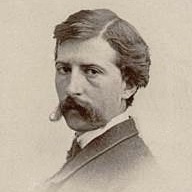
American painter and illustrator Winslow Homer was BOTD in 1836. Born in Boston, Massachusetts to a prominent New England family, he showed an early talent for art. After completing senior school, he was apprenticed to a commercial lithographer in Boston for two years. Determined never again to have a “master”, he worked as a freelance illustrator for 20 years, publishing scenes of rural New England in Ballou’s Pictorial and Harper’s Weekly. He moved to New York City in 1859, attending art classes at the National Academy of Design, and began oil and watercolour painting. In 1861, Harper’s sent him to the front lines of the Civil War, where he sketched battle scenes and camp life. After the war, he travelled to Europe, living in Paris for a year and sharing an apartment with old friend Albert Warren Kelsey. Their relationship had romantic and possibly sexual colourings: Kelsey referred to them as “Damon and Pythias”, alluding to the loving youths of Greek mythology, while Homer drew an erotic sketch of a naked Kelsey astride a sea turtle. Homer then spent two years travelling the English coast, painting nautical scenes and portraits of working people, establishing the major themes of his later work. Returning to America in 1882, he moved to his parents’ estate in Prouts Neck, Maine, which became his permanent studio, undertaking frequent travel to the Bahamas, Cuba and Florida in search of coastal and nautical scenes. By 1900, he was recognised as a major American artist, especially admired for his paintings Undertow and Eight Bells, portraying lone figures struggling against the brutal indifference of the sea. He died in 1910, aged 74. His work influenced later generations of American artists, notably Andrew Wyeth, whose work adopted Homer’s spare, sombre style. Typically characterised as a hermit who sacrificed (heterosexual) love for his career, biographers and art historians continue to debate Homer’s possible homosexuality, pointing to his relationship with Kelsey, his disinterest in women (in life and as erotic subjects in his work) and his recurring portrayals of muscular working-class men and heroic soldiers.
Winslow Homer

 Super Gays Born on this Day