
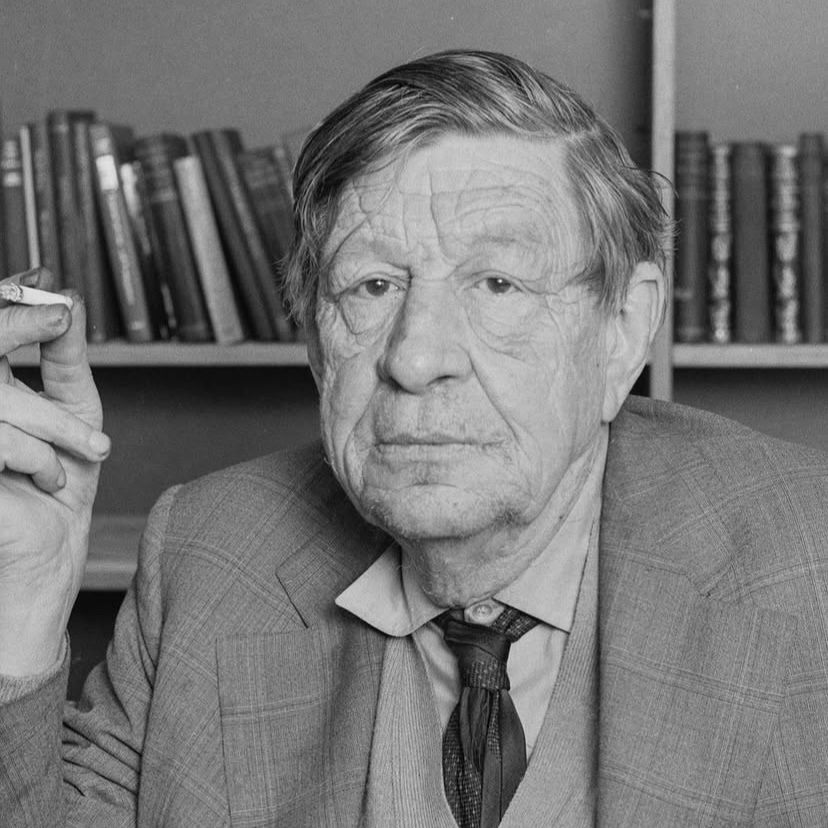
English poet Wystan Hugh (W. H.) Auden was BOTD in 1907. Born in York to an upper middle-class family, he grew up in Birmingham, and was sent to private boarding school, where he befriended Christopher Isherwood. He studied at Oxford University, joining a poetic circle including Isherwood, Cecil Day-Lewis, Louis MacNeice and Stephen Spender. He and Isherwood had an on-off relationship for many years, visiting Berlin together in the late 1920s to enjoy the sexual freedoms of the Weimer Republic. Auden published his first poetry collection in 1930, supporting himself as a teacher, journalist and documentary maker. In 1935, he married Erika Mann, the lesbian daughter of novelist Thomas Mann, allowing her to claim British citizenship and flee Nazi Germany. In 1939, he and Isherwood emigrated to America, living briefly in a writers’ colony in Brooklyn with housemates Gypsy Rose Lee, Carson McCullers, Benjamin Britten, Peter Pears and Paul and Jane Bowles. When Isherwood moved to California, Auden settled in New York with his boyfriend Chester Kallman, lecturing at The New School, Bennington and Smith universities. He published over 400 poems, notable for their wide variety of styles, ranging from high Modernism to ballads, limericks and haiku, with subjects ranging from pop songs to politics, love, sex, morality and religion. He also wrote opera libretti and published prose essays. Critical reception to his work ranged from adoration to contempt, but by the 1970s, he was venerated as an elder statesman of English poetry. He died in 1973 aged 66; a memorial stone was dedicated to him at Westminster Abbey. Sales of his work skyrocketed after his poem Funeral Blues was read in a funeral scene in 1994 rom-com Four Weddings and a Funeral. Alan Bennett’s 2009 play The Habit of Art dramatised Auden’s friendship with Britten, comparing Auden’s cheerful promiscuity with Britten’s closeted sexuality.
W. H. Auden

 Super Gays Born on this Day