
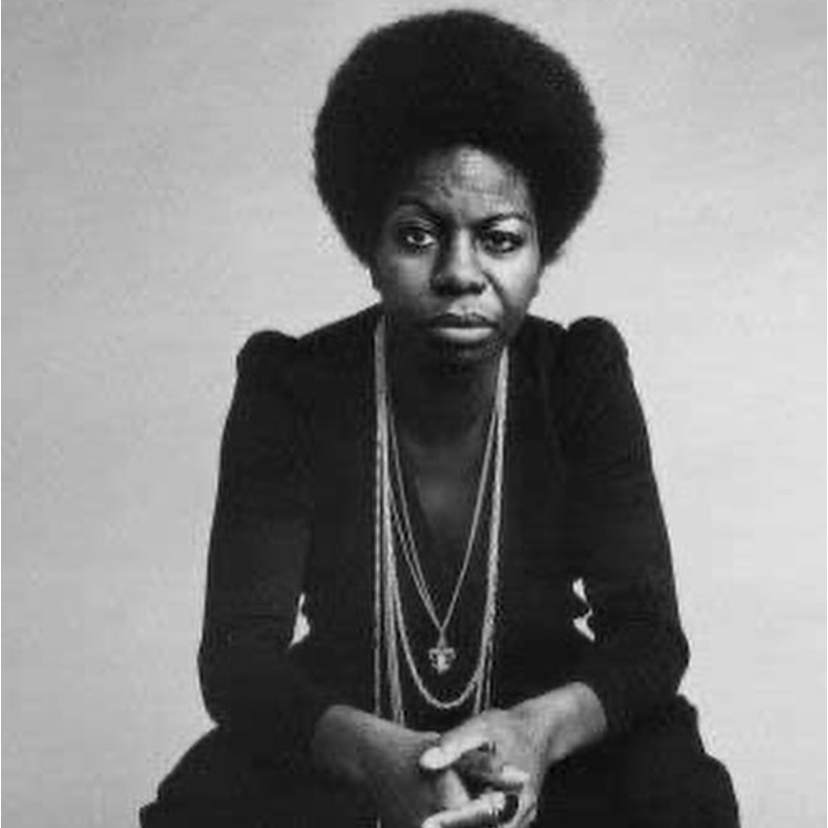
American singer-songwriter and activist Nina Simone was BOTD in 1933. Born Eunice Waymon in Tryon, a small town in rural North Carolina, she was a musical prodigy and groomed for a career as a classical pianist by wealthy white patrons. Rejected from the Curtis Institute of Music, she moved to Atlantic City where she began playing piano in a nightclub. Told that she would also have to sing, she began her career as a vocalist. With a powerful contralto voice and extraordinary musicianship, she developed a compelling, genre-bending sound, fusing classical, jazz, blues and soul influences. In the 1950s she moved to New York, befriending leading Black queer writers Langston Hughes, James Baldwin and Lorraine Hansberry, and joined the civil rights movement alongside Martin Luther King Jnr and Malcolm X. Her 1964 song Mississippi Goddam, written in protest after the Alabama church bombing, became the movement’s unofficial anthem. She also had hits with Young, Gifted and Black (with lyrics by Hansbury) and a stunning cover of the gospel song I Wish I Knew How It Feels To Be Free. Simone married police detective Andy Stroud in 1961, who later became her business manager. Their relationship was turbulent, and destabilised by Stroud’s physical and emotional abuse. Simone was bisexual, and was known to frequent New York lesbian bar Trude Heller’s. After her divorce from Stroud, she fell in love with an unknown woman with whom she had a brief relationship. Her later life and career was besieged by mental illness and a restless search for a home in America, Europe and Africa. She died in 2003, aged 70. Her life and work has inspired countless musicians, notably Lauryn Hill, John Legend and Kanye West, and received a critical re-appraisal during the Black Lives Matter movement. Her life and musical legacy was compellingly explored in the 2015 documentary What Happened Miss Simone?, followed by Alan Light’s biography of the same name. She was played by Zoe Saldaña in the 2016 biopic Nina. The film was a critical and commercial failure, largely prompted by criticism over the casting of the light-skinned Saldaña to play Simone.
Nina Simone

 Super Gays Born on this Day