
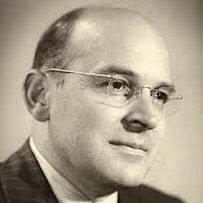
American lecturer, critic and writer Francis Otto (F. O.) Matthiessen was BOTD in 1902. Born in Pasadena, California to a prominent industrialist family, he was raised in Pasadena and later in New York after his parents’ separation. He studied at Yale University, then won a Rhodes Scholarship to study at Oxford University. He completed his doctorate at Harvard University, working there as a teacher and professor for the rest of his life. He is best known for his 1941 book American Renaissance: Art and Expression in the Age of Emerson and Whitman, a critical study of the work of 19th century American writers Ralph Waldo Emerson, Henry David Thoreau, Herman Melville, Walt Whitman and Nathaniel Hawthorne. A landmark text, it helped bolster the conception of American literature as a distinct literary and nationalist movement. Matthiessen also helped revive interest in the work of Henry James, popularised the work of T. S. Eliot for American readers and published a book about American lesbian poet Sarah Orne Jewett. A devoted Socialist, he supported left-wing and progressive political causes, encouraging the formation of trade unions for teachers and academics. Matthiessen had a 20-year relationship with the painter Russell Cheney, his classmate at Yale. Their private correspondence revealed Matthiessen’s struggles to accept his homosexuality and exist in a homophobic society, an ambivalence that found its way into his literary criticism. A champion of the openly-gay Whitman, Matthiessen nonetheless critiqued the poem Song of Myself for the “passivity of the poet’s body”, which he described as “vaguely pathological and homosexual”. After Cheney’s sudden death in 1945, Matthiessen sank into a deep depression, compounded by the anti-Communist and anti-gay purges of Senator Joseph McCarthy. He committed suicide in 1950, shortly before he was due to appear before the House Un-American Activities Committee, by jumping from a hotel window. He was 48.
He committed suicide at the age of 48.

 Super Gays Born on this Day