
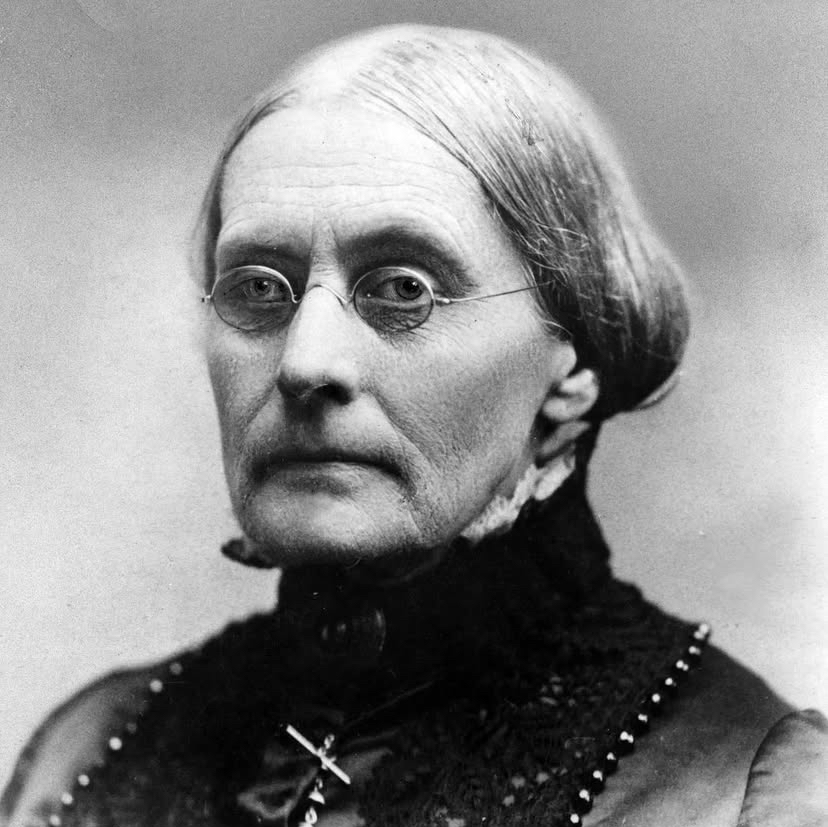
American activist and social reformer Susan B. Anthony was BOTD in 1820. Born in Adams, Massachusetts to a Quaker family, her parents were involved in the anti-slavery movement. Relocating to upstate New York, her family became friends with abolitionist Frederick Douglass and suffragette Elizabeth Cady Stanton. She became a popular public speaker, campaigning for anti-slavery, temperance and women’s rights causes, and co-edited The Revolution, a weekly suffragist’s newspaper with Stanton. An early victory included campaigning for legislation to allow married women to own their own property, enter into contracts independently of their husbands and be joint guardians of their children. Anthony also famously opposed an amendment that would deny the vote to women of colour, setting her at odds with more conservative feminist organisations. In 1873, she was put on trial for attempting to register to vote, bringing national attention to the suffrage movement. She became leader of the National American Women Suffrage Association in 1890, and was one of the earliest American delegates to the International Council of Women. Publicly presenting herself as a spinster who dedicated her life to politics, Anthony had a series of erotically-charged friendships with women throughout her life, including Anna Dickinson, Sally Ackley and Emily Gross. Anthony’s niece Lucy lived openly in a lesbian relationship with fellow campaigner Anna Howard Shaw. Anthony died in 1906 aged 83. Thirteen years later, the Nineteenth Amendment to the Constitution was passed, guaranteeing women’s suffrage, and was nicknamed The Susan B. Anthony Amendment. Amid many posthumous honours, she became the first woman featured in US currency, appearing on the 1979 one-dollar coin.
Susan B. Anthony

 Super Gays Born on this Day