
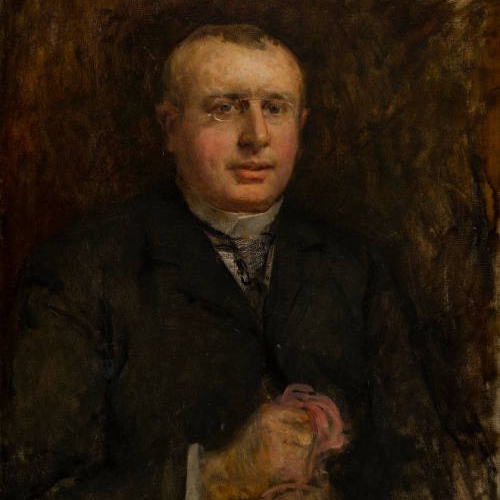
Irish playwright and politician Edward Martyn was BOTD in 1859. Born in Tullira in County Galway to a wealthy Catholic family, he inherited Tulira Castle when he was a year old after his father’s death. Schooled in Dublin and London, he attended Oxford University, though left without taking a degree. He began writing plays in the 1880s, and became a central figure in the early 20th century Irish cultural revival. In 1896, he introduced his friend William Butler Yeats to Lady Gregory. The three founded the Irish Literary Theatre for the production of Irish plays. Martyn underwrote the company’s first three seasons, writing and producing two of its most popular plays, The Heather Field and A Tale of a Town. His dislike of the “peasant plays” produced by Revivalist playwrights Sean O’Casey and John Millington Synge led to him breaking with Yeats and the theatre’s closure. In 1914, he founded the Irish Theatre in Dublin to produce “non-peasant plays”, Irish language dramas and works by European playwrights. A keen musician, he also founded the Palestrina Choir and sponsored the Feds Ceoil, an annual classical music competition. He broke with family tradition by becoming a die-hard Republican, protesting British Royal family visits to Ireland, and became the first president of Irish nationalist party Sinn Féin. In 1906, he made an off-the-cuff remark that any Irishman who joined the British Army should be flogged, leading to his suspension from the private-member Kildare Street Club. Martyn took the club to court and won, later saying he only pursued the case to stay a member as it served the best caviar in Dublin. A lifelong bachelor, his homosexuality appears to have conflicted with his devout Catholicism. He developed a series of unrequited crushes on Yeats and artist Eduoard Manet (who painted his portrait three times). He died in 1923, aged 64. He was outed as gay after his death by his cousin and frenemy George Moore, who wrote a blistering account of Martyn in his 1914 memoir Hail and Farewell.
Edward Martyn

 Super Gays Born on this Day