
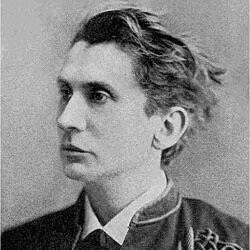
Austrian aristocrat and novelist Chevalier Leopold von Sacher-Masoch was BOTD in 1836. Born in Lemburg, Galicia in the Austro-Hungarian Empire (now Lviv in Ukraine), both his parents were descended from aristocratic families, and were eventually granted the title of Von Sacher-Masoch by Emperor Franz Joseph I. Raised in Lemburg and Prague, he studied law, history and mathematics at Graz University, later becoming a lecturer and publishing a series of books about European history. Freed from the need to earn his living due to an inheritance, he became a full-time writer, publishing a series of short stories based on Galician and Jewish folklore, and attracting celebrity fans including Victor Hugo, Émile Zola and Henrik Ibsen. His interest in erotic fiction began with his 1866 novel Don Juan von Kolomea, exploring themes of domination, submission and characters who welcome pain and abuse from lovers. In 1869, he embarked on a cycle of novellas exploring the “evils” of contemporary society, tentatively titled Das Vermächtnis Kains (Heritage of Cain). The first volume, Die Liebe (Love) was published in 1870, containing Venus im Pelz (Venus in Furs), an erotic fantasy about an aristocrat named Severin who becomes the sex slave of his dominant, fur-wearing mistress Wanda, enthusiastically submitting to her beatings and humiliations. Though presented as fiction, the story was widely read as a roman-a-clef, based on Sacher-Masoch’s sexually submissive relationship with his mistress Fanny Pistor. Its publication caused a scandal, badly damaging his reputation, though attracted praise from the notoriously gay King Ludwig II of Bavaria. In 1873, Sacher-Masoch married the writer and translator Angelika Aurora von Rümelin, with whom he had three children. Their relationship was strained by Sacher-Masoch’s financial difficulties, eventual bankruptcy and numerous infidelities, leading to their separation in 1886. He moved with his mistress Hulda Meister to her estated in Lindheim, where he continued to write and publish. His notoriety exploded in 1890 following the publication of Austrian sexologist Richard von Krafft-Ebing‘s text Psychopathia sexualis, in which Krafft-Ebing coined the term “masochism” to describe sexual pleasure gained from pain and humiliation. An enraged Sacher-Masoch protested Krafft-Ebing’s unauthorised use of his family name and diagnosis of sexual perversion, though was unable to prevent its publication. In 1893, he founded an educational institute to counteract anti-semitism through the establishment of libraries, public lectures and theatre and music performances. In later life, he suffered from mental illness, and was eventually confined to an asylum, where he died in 1895, aged 59. Krafft-Ebing’s theory of masochism was further popularised by Sigmund Freud, who posited a psychological connection between sadism and masochism, which he termed “sadomasochism”. In response to renewed interest about Sacher-Masoch, von Rümelin published a memoir Meine Lebensbeichte (My Life Confession) in 1906, detailing their marriage and sex life and reproducing the text of their “slave contract”. Venus in Furs has remained continuously in print, inspiring numerous film and stage adaptations, and a song of the same name by alternative rock group The Velvet Underground. Scholars have also speculated on Sacher-Masoch’s bisexuality, pointing to Severin’s attraction to a handsome Greek aristocrat who brutally beats him: “He was a handsome man, by God. No, more: he was a man such as I had never seen in the flesh. He stands in the Belvedere, hewn in marble, with the same slender and yet iron muscles, the same face, the same rippling curls…. Now I understood male Eros and admired Socrates for remaining virtuous with Alcibiades.”
Leopold von Sacher-Masoch

 Super Gays Born on this Day