
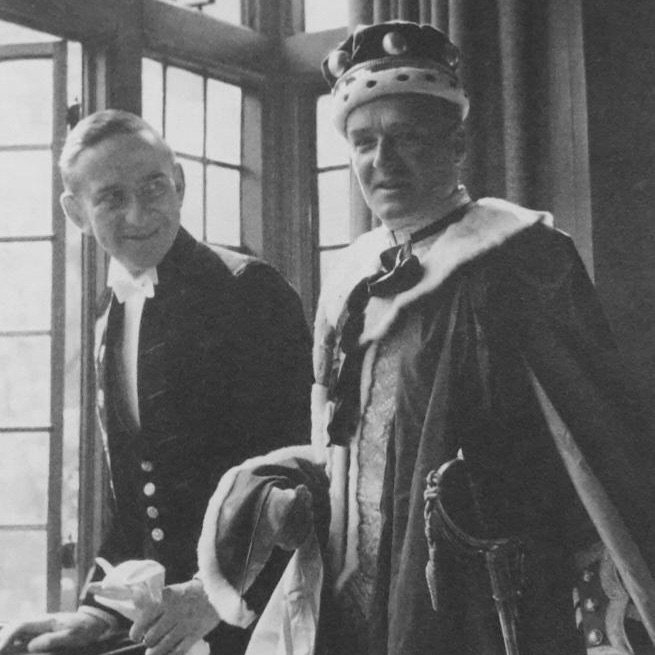
English architect Paul Edward Paget was BOTD in 1901. Born in London to an upper-middle-class family, his father was the Bishop of Chester. He studied at Cambridge University, where he met architecture student John Seely. They became lovers, and were soon inseparable, referring to each other as “the partner”. “It was just the marriage of two minds,” Paget later said, “we became virtually one person”. After graduating, Paget returned to London to work in a bank, until Seely saved him by announcing they would start an architectural firm together. Despite his lack of architectural training, Paget became the face of the company, securing business and cultivating client relationships. Their first domestic job was the restoration of Mottistone Manor on the Isle of Wight for Seely’s father. In 1930, they bought 41-42 Cloth Fair in Smithfield, thought to be the oldest house in London, and undertook an ambitious renovation project: installing separate baths in the bathroom so they would soak together, blocking up windows in the house opposite that overlooked their kitchen, and commissioning the artist Brian Thomas to paint a mural of a sailor returning home to his family (in Paget’s words “a delightful thing to look at”). Their business became so successful that they were later able to buy most of the buildings in their street. Their most important commission was the refurbishment of Eltham Palace, a medieval stately house in Greenwich which had been the childhood home of King Henry VIII. Its tenants Stephen and Virginia Courtauld commissioned Seely and Paget to design a modern home that incorporated the medieval palace remains. Seely’s Art Deco-inspired designs, while initially controversial, were widely acclaimed and are now considered a masterpiece of British Art Deco architecture. After World War Two, he and Paget restored a number of bomb-damaged London buildings, including Westminster Abbey, Lambeth Palace, Eton College and the London Charterhouse, and also designed the new church of St Andrew and St George in Stevenage. In 1947, Seely was appointed Surveyor to the Fabric of St Paul’s Cathedral, who planned extensive renovations to the church interior. Seely died in 1963, midway through the St Paul’s project. Paget succeeded him as Surveyor, overseeing the completion of the work, but was unable to continue the practice without his partner. He retired in 1969, and received a number of honours, including Fellowships of the Royal Institute of British Architects and the Society of Antiquaries and Master of the Art Workers Guild. In 1970, aged 70, he married the children’s writer Verity Anderson, living with her and her three children at a home in Norfolk that he and Seely had built for Paget’s uncle. Paget died in 1985, aged 84.
Paul Edward Paget

 Super Gays Born on this Day