
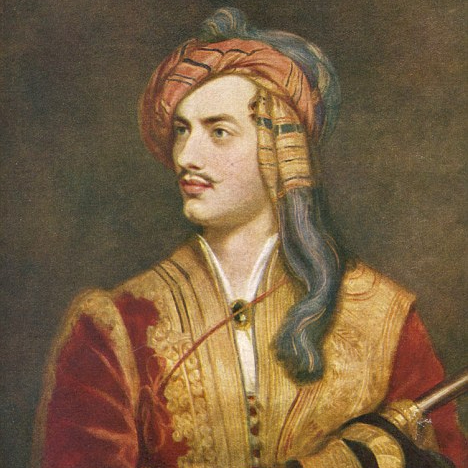
English writer and adventurer George Gordon, Lord Byron was BOTD in 1788. Born in London to an aristocratic family, he inherited the family baroncy when he was 10. He was educated at Harrow and Cambridge, where he had affairs with men and women, embraced liberal politics and published his first poetry collection. He travelled extensively through Europe before settling in Italy for seven years and actively pursuing sexual relationships with men. His epic poem Childe Harold’s Pilgrimage, based on his travels, was published in 1812, making him the star of literary London, while his good looks and stories of his omnivorous sex life brought him scandal and infamy. (His friend and lover Lady Caroline Lamb famously called him “mad, bad and dangerous to know”). After entering into an incestuous relationship with his half-sister Augusta Leigh, he married Annabella Millbanke, with whom he had a daughter, Ada. His rampant infidelity brought the marriage to an abrupt end, while his debts forced him to leave England in 1816. He continued his travels through Italy and Armenia, publishing the autobiographical poem Don Juan and shagging anything that moved. In 1823, he joined the Greek army in their war of independence against the Ottoman Empire. He died in 1824 of injuries sustained in battle, aged 36. Hailed as one of the foremost figures of the Romantic movement, he inspired the word “Byronic”, to describe an alluringly mysterious and brooding (male) hero. His life and work have inspired tributes in music and literature, and he has been played onscreen by George Beranger, Gabriel Byrne, Richard Chamberlain, Hugh Grant and Johnny Lee Miller.
Lord Byron

 Super Gays Born on this Day