
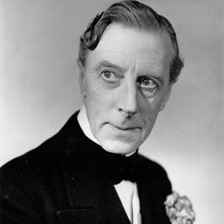
English actor Ernest Thesiger was BOTD in 1879. Born in London to an aristocratic family, he was educated at Marlborough College before studying painting at the Slade School of Art, where he fell in love with his classmate William Bruce Ellis Ranken. Lured to a career on the stage, he made his professional debut in 1909. In World War One, he volunteered with the British Army’s Territorial Force before being conscripted for active duty, and was sent to the Western Front. Wounded in 1915, he was invalided back to Britain, and began making and selling needlepoint kits as a form of activity and income for wounded soldiers. When asked about his experiences in France, he was reported to have said “Oh, my dear, the noise! And the people!” He became a West End star in 1915 in the farce A Little Bit of Fluff, appearing in the role for nearly three years and appearing in the 1919 silent film version. In 1917, he married Ranken’s sister Janette, presumably to remain close to the family. (When hearing of their engagement, William shaved his head in protest). They appear to have had an open marriage, allowing Thesiger to pursue affairs with men. He consorted with a largely homosexual social group, including painter John Singer Sargent, novelists Ivy Compton-Burnett and W. Somerset Maugham, and became friends with Queen Mary, who commissioned him to embroider an altar frontal for Buckingham Palace. An old friend of Noël Coward, he appeared in drag in Coward’s 1925 comedy On with the Dance, and originated the role of the Dauphin in George Bernard Shaw’s play Saint Joan. Thesiger reputedly encouraged Maugham to write him theatrical roles, to which the playwright responded “But I am always writing parts for you, Ernest. The trouble is that [actress] Gladys Cooper will insist on playing them.” Thesiger is best known for his collaborations with filmmaker James Whale, who brought him to Hollywood in 1932 to star in The Old Dark House with Charles Laughton. His best-known film role was the effeminate Dr Septimus Pretorius in Bride of Frankenstein, Whale’s phenomenally successful 1935 sequel to Frankenstein, appearing opposite Boris Karloff, Elsa Lanchester and Colin Clive. On his arrival in Hollywood, Thesiger set up a display of his needlework in his hotel suite for sale to visitors. He was then cast in a film adaptation of H. G. Wells’ novel Things to Come, though Wells considered his performance “unsuitable” and he was replaced by another actor. He returned to London and spent most of his later career in the theatre, though had eye-catching roles in The Man in the White Suit and The Horse’s Mouth with Alec Guinness, the 1960 film version of D. H. Lawrence‘s novel Sons and Lovers, and Tennessee Williams‘ The Roman Spring of Mrs Stone with Vivien Leigh. He made his final stage appearance in 1961 in The Last Joke with John Gielgud and Ralph Richardson, dying later that year, aged 81. He was played as a raging queen by Arthur Dignam in Bill Condon‘s 1998 film Gods and Monsters, in a scene recreating the filming of Bride of Frankenstein.
Ernest Thesiger

 Super Gays Born on this Day